Showing posts with label Church. Show all posts

Thursday, February 18, 2010

When Can A Priest Say The Traditional Latin Mass?

(Telegraph) - Good news from Rome: the Vatican has further underlined the freedom of priests to celebrate Mass in the Extraordinary Form whenever they choose. Two important points have been clarified by Ecclesia Dei, which will make it more difficult for the English, Welsh and above all Scottish bishops to stall the implementation of Summorum Pontificum:

1. A priest does NOT have to be approached by a “stable group” of the faithful in order to schedule a PUBLIC celebration of the Extraordinary Form – he may choose to do so, for example, in order to introduce his parishioners to this ancient form of the Roman Rite. Or because it’s his aunt’s birthday. Any reason, really.

2. A Mass in the Extraordinary Form may replace a regularly scheduled Mass in the Ordinary Form.

You can find more details of the Ecclesia Dei ruling here, on the excellent New Liturgical Movement blog....

read full story here
THE CATHOLIC KNIGHT: Rome has spoken again. While rebel priests and bishops from all over the western world seek new ways to twist canon law and thwart the pope's will, the Vatican has now ruled the following. Any Roman Rite Catholic priest may celebrate the Traditional Latin Mass (Tridentine mass, Extraordinary Form or Usus Antiquior) or "Ancient Use" at any time, whenever he wants, for any reason, or no particular reason at all. It can be done privately (with or without guests), or publicly, and it may replace any ordinary mass at any time. The one and only requirement is that the priest be competent to celebrate it, and there are many means through which a priest may attain competency, either through training videos or short workshops.

Pope Benedict XVI has effectively given the Usus Antiquior ("Ancient Use") just as much freedom in the modern Church as the ordinary modern mass. This freedom will prove essential to younger priests, just coming out of the seminaries, who tend to be more traditional in their liturgical practices, and will immediately be confronted by retro-1970s priests serving as rectors, chancellors and bishops. The retro-1970s clergy tend to express an open hostility toward the Usus Antiquior and/or anything having to do with traditional liturgical practices. For years now, young priests have found themselves immediately immersed in a culture of intimidation if they should display any traditional tendencies in diocesan parishes. "When you're fresh out of the seminary, and trying to please your superiors, there is tremendous pressure to just go along with the flow and maintain the status quo" said one newly ordained priest to 'The Catholic Knight' under condition of anonymity.

That "pressure" may still be there, but the "power" of these retro-1970s throwbacks to do any harm has now been significantly diminished. Young priests, fresh out of the seminaries, can now offer the Usus Antiquior whenever they want, and while they may incur the frowns and glares of their superiors, there is nothing they can lawfully do to stop them anymore. This most recent act by the Vatican signifies that the retro-1970s post-conciliar neopriests are now finally being put out to pasture.

Wednesday, November 18, 2009

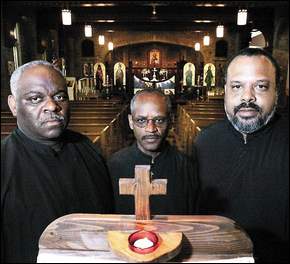
More African-Americans Are Turning To Eastern Orthodoxy

Many black Christians join move to Orthodox traditions

After a lifetime in traditional black churches, Robert Aaron Mitchell discovered the sights, smells, sounds and ancient traditions of the Orthodox church.

"I discovered Orthodoxy while I was on the Internet one day back in 2001, and I was so drawn to it that I had to go attend a liturgy," Mitchell says. "I had no frame of reference for these traditions, but suddenly, I felt like this void was filling in my life. I felt like I was finally coming home."

Mitchell, 48, a project manager for AT&T in Detroit, is among a small but growing number of black Americans, many of them professionals, who are joining Orthodox churches. That's the branch of Christianity that split with Rome about 1,000 years ago and is known for colorful icons and the ethnic traditions it preserves in religious customs.

The attraction, Mitchell says, lies in discovering that for thousands of years, Africans played a vital role in the Orthodox world.

The Rev. Moses Berry, an Orthodox priest and pastor of Theotokos "Unexpected Joy" Orthodox Mission, Ash Grove, Mo., began his career as a Protestant preacher, a family tradition reaching back into the 1800s. Then, in 1983, he visited an Orthodox church in Atlanta and was so moved that he retrained to become a priest in the Orthodox Church in America. He also helped to organize the coalition of clergy, scholars and lay leaders coming to Detroit.

"Reconnecting with the Orthodox tradition connects us with the earliest Christian traditions," Berry says. "It means that, when our ancestors were brought here as slaves, they didn't arrive here with just a collection of tribal religions. They didn't all discover Christianity here. In fact, many Africans already were part of the ancient Christian church."

That was especially true for Africans with roots in the eastern part of the continent, Laike-Mariam Misikir, 50, says. An automotive engineer from Ann Arbor, Mich., Misikir is from a family of Orthodox priests that extends back many centuries in Ethiopia. In Detroit, Misikir serves as a subdeacon, assisting priests during liturgies...

read full story here

THE CATHOLIC KNIGHT: Talk about getting in touch with your roots -- wow! This is really good news, because ancient African Christianity is so rich in tradition and culture. It makes sense that African-Americans would be attracted to this. It makes a lot more sense than the 'black Muslim' movement we saw back in the 1960s. Africans were Orthodox Christian long before Islam came along. The first black Christians were baptized way back in the middle first century. (It's actually recorded in the Bible -- Acts 8:26-39.) While the first black Muslims didn't come along until six-hundred years later. In fact, many Africans were worshipping the one true God, with dignity and beauty, while northern Europeans were still worshipping the sun, moon and trees. That's just a matter of historical fact. Northern Europe wasn't evangelized by Christianity until the middle 5th century. So there is a lot of cultural recovery to be gained by African-Americans returning to their Christian roots in Africa. The dignity and beauty of the Eastern Orthodox liturgy is second to none. Only the traditional Latin mass of Catholicism comes close, and even then there is some debate. I sincerely hope this movement takes off. It would be a wonderful thing.
The Brotherhood of St Moses the Black is a pan-Orthodox nonprofit organization. Its mission is to minister to Americans the gift of Orthodoxy. In an effort to be good stewards of the manifold grace of God (I Peter 4:10), the organization presents an annual conference that targets those who have little exposure to Orthodoxy as well as the African roots of Orthodoxy. Its vision is to bring Americans closer to Jesus Christ.
Links to Orthodox Churches in the United States:
http://www.oca.org/
http://www.goarch.org/
http://www.copticchurch.net/

Saturday, August 1, 2009

Pope Calls Upon ALL Catholics - "Kneel For Communion"


THE CATHOLIC KNIGHT: The directives have already been issued, the example has been set, the call has been made. The Holy Father, Pope Benedict XVI, is calling upon all Catholic laity to boldly and obediently kneel for communion, and receive on the tongue, regardless of what the normal practices are in your local parish. Future decrees on this may be made public at a future date, but the Holy Father is calling upon the lay faithful to begin acting now. No priest or bishop has the authority to stop you, lecture you, or deny you communion for this. From now on, anyone who kneels before the Blessed Sacrament, and receives on the tongue, is not only showing proper adoration to our Eucharistic Lord, but is also demonstrating obedience to the Holy Father. Of course, people with physical infirmities that prevent them from kneeling are exempt, but they can still receive on the tongue as a sign of adoration and obedience.
(News Blaze) - Pope Benedict XVI does not want the faithful receiving Communion in their hand nor does he want them standing to receive Christ in the Blessed Sacrament. According to Vatican liturgist, Monsignor Guido Marini, the pope is trying to set the stage for the whole church as to the proper norm for receiving Communion for which reason communicants at his papal Masses are now asked to kneel and receive on the tongue.

The Holy Father's reasoning is simple: "We Christians kneel before the Blessed Sacrament because, therein, we know and believe to be the presence of the One True God." (May 22, 2008)

According to the pope the entire Church should kneel in adoration before God in the Eucharist. "Kneeling in adoration before the Eucharist is the most valid and radical remedy against the idolatries of yesterday and today" (May 22, 2008)...

read full story here

Friday, July 17, 2009

Catholic Men Should Be Knights Not Masons


THE CATHOLIC KNIGHT: The Knights of Columbus, of which I am a 4th degree member, is a fraternal Catholic order with a membership of some 1.7 million men. It is designed primarily to serve the Catholic Church, and secondarily the men who are members, by providing a means and conduit through which they may help each other, their families, the Church and third-party charities. The Knights of Columbus also provides life insurance policies to it's members and uses the proceeds to benefit the Catholic Church in various ways.

The Knights of Columbus was founded by The Venerable Father Michael J. McGivney in New Haven, Connecticut on August 2, 1881. His primary motivation was to organize a mutual benefit society to assist widows and orphans of families who had lost their primary bread winner. Life in the late 1800s was extremely harsh for Catholic immigrant families in the United States. During that time discrimination made it difficult for a Catholic man to get a good job. Catholics were regularly excluded from labor unions. Local charities and benefit organizations also frequently excluded Catholics. Catholics were also disenfranchised politically, as it was nearly impossible to get a Catholic elected to government office. Most Catholic men were forced to work in coal mines, sweat shops and ship yards, where they were subjected to harsh labor, poor working conditions, and less then minimum wage. As a result, many Catholic husbands and fathers lived short lives. The one organization well established in America, which could potentially help them, was Freemasonry. Unfortunately, Freemasonry had a strong religious/occult element that challenged the Catholic Church's claim of absolute truth revealed through the incarnation of Jesus Christ. Because of this, Freemasonry was soundly condemned by the Catholic Church. In addition to that, the Church also had significant political problems with Freemasonry in Europe.

These things prohibited Catholic men from joining the Freemasons under penalty of excommunication. In the late 1800s, this put many Catholic men in the terrible situation of having to choose between the Church and the welfare of their families. The Venerable Father McGivney sought to create a Catholic men's organization that would allow men to pool their resources, talents and energies for the common good and for the sake of their families, but he sought to do so without the religious/occult element that earned Freemasonry the scorn of the Catholic Church.

So the Knights of Columbus was formed under the ancient precepts of medieval chivalry, paralleling in some ways the degree programs used by the Freemasons, but without the unchristian oaths and occult rituals. The Vatican prohibition against Freemasonry remains today, and the reasons for this are fully explained by Catholic apologist John Salza (learn more here). According to the New Code of Canon Law (1983), this prohibition remains in effect under penalty of interdict.

The Venerable Father McGivney initially authored three degrees though which the Knights of Columbus would receive their initiation into the order.

Now if you looking to know the secrets of the degree rites, you won't find them here. 'The Catholic Knight' has taken a pledge not to reveal them on my honor. However, I should point out here that what I have taken is a pledge, not an oath, and there is a significant difference. A pledge is a promise. That is all. It is based on one's honor. Nothing is sworn, and there are no penalties if the pledge is broken. All that is lost is the honor of the man who broke the pledge, simple because he did not keep his promise. When I took my degree rites, I pledged not to tell what goes on there based entirely on my honor as a practicing Catholic man. No threats were made, and no penalties were warned. If I tell the secrets, nobody is going to slit my throat or cut my heart out. Nobody is going to kill me or harm me. Nobody is going to seek retribution against my family or business. I'll still be able to get a good job. I'll still be able to do business. I might even still be allowed to keep my membership in the Knights of Columbus. However, I will have lost my honor. I made a promise, and I would not have keep it. That prospect alone, is enough to keep me quiet. For I wish to be an honorable man. That's why you won't find the degree rite secrets here.

In addition to that, these pledges are made with the explicit exception to religious or civil duty. So for example, if my priest or bishop needed to know something about my knowledge of the degree rites, I could reveal that to them even if they were not members of the Knights of Columbus, without breaking my pledge. Furthermore, if an officer of the law, judge or courtroom attorney needed to know my knowledge of the degree rites, again, I could reveal that information without breaking my pledge. That's because these exceptions of civil and religious duty are explicitly written into the pledges. I could take it a step further, and some of my brother knights may take issue with this, but so be it. If my wife, whom I am sacramentally bound to in matrimony, for some reason needed to know my knowledge of the degree rites, again citing religious duty to honor this holy sacrament of matrimony, I could reveal that information without breaking my pledge.

When I took my pledges, I did not swear on anything. I did not call curses upon myself. I did not use the Lord's name in vain. I simply made a promise. That is a pledge. Unlike an oath, which frequently involves swearing, calling down curses upon one's self if the oath is broken, and often invokes the name of someone holy (like God for example) to bind one to the oath. Freemason's do take oaths, and that is very much a part of their degree rites. In contrast, Knights of Columbus do not take oaths. It is not part of our degree rites. And this is because the Scriptures are very clear...
"Thou shalt not take the name of the Lord thy God in vain: for the Lord will not hold him guiltless that taketh his name in vain." - Exodus 20:7

"Again, ye have heard that it hath been said by them of old time, Thou shalt not forswear thyself, but shalt perform unto the Lord thine oaths: But I say unto you, Swear not at all; neither by heaven; for it is God's throne: Nor by the earth; for it is his footstool: neither by Jerusalem; for it is the city of the great King. Neither shalt thou swear by thy head, because thou canst not make one hair white or black. But let your communication be, Yea, yea; Nay, nay: for whatsoever is more than these cometh of evil." - Matthew 5:33-37

"But above all things, my brethren, swear not, neither by heaven, neither by the earth, neither by any other oath: but let your yea be yea; and your nay, nay; lest ye fall into condemnation." - James 5:12
Now as for the degree rites themselves, this is what I can tell you without breaking my pledge...
  1. They are based on (1st degree) Charity, (2nd degree) Unity and (3rd degree) Fraternity. There is of course the optional 4th degree of Patriotism which was developed later. But these first three degree rites were crafted by The Venerable Father McGivney himself.
  2. Everything taught in these rites is 100% Biblical. There is no occult or "secret knowledge" conveyed in the Knights of Columbus. You could just as easily find the lessons of these degree rites in a Sunday homily or Scripture reading.
  3. Lessons are best remembered when emotion is attached to them. For example, when you get a good scare, you are far more likely to remember the lesson associated with it. A similar thing could be said for positive emotions as well, such as relief and joy.
  4. The degree rites are specifically designed to evoke emotion on the part of the candidate who is taking the rite.
  5. Because the degree rites are designed with the intent of evoking emotion, they MUST be kept secret, so as not to spoil the surprise for the candidate. The candidate must be unaware of what will happen, lest it spoil the intended emotional response, and the lesson of the degree rite be lost to mundane procedure, failing to leave an indelible mark on the candidates heart and mind.
  6. There is no ritual hazing in the Knights of Columbus, and nothing is ever done that would undermine the dignity of a Catholic man.
  7. Degree candidates are not ever asked to divulge deep dark secrets about themselves, nor say anything that would compromise their integrity, nor put themselves into a compromised position.
  8. Alcohol is never used, and is not permitted, during degree rites.
  9. Knights and candidates are exhorted to be good Catholic Christians, and to show no partiality between members and non-members. As Catholic Christians, knights do not look down upon non-members, nor are they permitted to consider themselves "better Catholics" simply because they are knights.
  10. Priests are permitted to audit and observe degree rites, nothing within the order is kept secret from the hierarchy of the Catholic Church. This is one reason why the Church has historically supported the Knights of Columbus and is currently considering the order's founder, The Venerable Father Michael McGivney, for canonization as a Saint.
  11. While the Knights of Columbus offers quality life insurance to it's members, at a reasonable price, no member is required to buy it. Nor is any member "pressured" to buy it. The insurance plans are simply offered as a benefit.
  12. Membership in the Knights of Columbus has many other benefits besides life insurance.
I'm afraid that's all you'll learn from me. Some might say I've already said too much. If so, I apologize, but I do not believe I have revealed any of the secrets of the order, nor do I believe I have violated my pledge to keep the elements of the degree rites secret. Personally, I have found my experience with the Knights of Columbus to be a rewarding one. Simultaneously, I have taken time away from the Knights of Columbus as well, so as to attend to family matters, in which my brother knights have always been very understanding and assured me that family comes first. They have also been quick to offer assistance whenever I was faced with personal and business difficulties.

If your a Catholic man who would like to learn more about the Knights of Columbus contact your local chapter. Personally, I would encourage getting involved in a knights council that is directly attached to a particular parish. This helps coordinate parish and knight activities in such a way that they become mutually beneficial.

* 'The Catholic Knight' blog does not speak for the Knights of Columbus organization, nor do the 'Knights of Columbus' necessarily approve the contents of this blog. 'The Catholic Knight' makes this blog entry merely as a testimony of my own personal experience.

Wednesday, September 24, 2008

Hitler's Pope

(Philadelphia Evening Bulletin) - ...Hitler's Pope has been criticized for its accuracy and dedication to objective history, and Mr. Cornwell admits that since its publication, his views have undergone revision.

"While I believe with many commentators that the pope might have done more to help the plight of the Jews, I now feel, 10 years after the publication of my book, that his scope for action was severely limited and I am prepared to state this," he said....

read full story here
THE CATHOLIC KNIGHT: Ten years after the bombshell book, hyper media criticism, and forty years after the communist propaganda first hit the American public, Pope Pius XII has finally been vindicated....
(ANSA) - Vatican City, September 17 - New research clears controversial wartime pope Pius XII from the accusation that he did not do enough to save Jews, Pope Benedict XVI said on Thursday.

It is the first time the pope has come out publicly to defend the record of his WWII predecessor, who is moving towards sainthood despite accusations of keeping silent about the Holocaust....

.... The pope thanked the Pave the Way Foundation, made up of Catholics and Jews, for uncovering the evidence in favour of Pius.

He voiced the hope that further studies can reinforce ''the historical truth, overcoming all remaining prejudice''. Benedict's statement on the new research - which has not yet been made public - follows last year's assertion by his No.2, Cardinal Tarcisio Bertone, that people ignore evidence disproving Pius was indulgent towards Hitler.

Pius was the victim of a ''black legend'', said Bertone, the Vatican Secretary of State....

read full story here

-----------------

(CWNews.com) - The Vatican has confirmed the existence of a directive from Pope Pius XII, asking Catholic clergy and religious to shelter Jews from the Holocaust.

Cardinal Tarcisio Bertone (bio - news), the Vatican Secretary of State, acknowledged in short April 19 announcement that Pope Pius XII issued instructions for all religious institutions to open their doors to Jewish people. The catacombs of Rome were also made available for shelter....

read full story here

-----------------

(CNA).- A former high-ranking officer with the KGB claims that the Kremlin and the Russian intelligence agency in the 1960s were set on executing a smear campaign against the Catholic Church, and the main target was Pope Pius XII.

In a recent issue of the National Review Online, Lt. General Ion Mihai Pacepa, who eventually defected from the former Soviet bloc, recounts how the KGB and the Kremlin designed the deliberate campaign to portray the Pius XII “as a coldhearted Nazi sympathizer.”

“In February 1960, Nikita Khrushchev approved a super-secret plan for destroying the Vatican’s moral authority in Western Europe,” writes Pacepa. “Eugenio Pacelli, by then Pope Pius XII, was selected as the KGB’s main target, its incarnation of evil, because he had departed this world in 1958. ‘Dead men cannot defend themselves’ was the KGB’s latest slogan.”

The code name for this operation against Pope Pius XII was “Seat-12.”

read full story here
There was no "Hitler's Pope." The whole thing was a fabrication, a lie, invented by the Soviet KGB, in a plan called "Seat 12," devised for the sole purpose of undermining the moral authority of the Catholic Church over the western world. It was enthusiastically embraced by the enemies of the Catholic Church on both sides of the political spectrum. The Secular Left loved it! The Religious Right used it. (I even had a Jehovah's Witness at my door preach it to me.) Oh how eager so many where to believe the lie! Even some Catholics jumped on the bandwagon. The criticism from the Left-wing biased media was unending. We heard it from all the major television and cable networks. After Cornwell's 'Hitler's Pope' was published, literally dozens of knock off books followed. The television preachers, oh how many television preachers, included it in their sermons. Some Evangelical authors included it in their own books on apologetics and eschatology.  Millions upon millions of unsuspecting Evangelicals were subjected to this lie, many of whom still believe it, because they trust the television preacher who told them. (I can't even count the number of times I've been confronted about it by misinformed Evangelicals.) It was perhaps one of the greatest lies of our time - the whopper of the century!

We can learn a lot about those who enthusiastically embraced it, who went out of their way to spread it around, and took every opportunity to rub it in the face of any Catholic who would dare defend the Church on anything. Shall we call it "prejudice?" Perhaps "bigotry" might be a better word. So what are we to say of those Catholics who actually embraced it, using it as an excuse to rationalize their opposition to the Church on this issue or that? What shame! What scandal! What embarrassment! Shame on all those who engaged in this nonsense! Dishonor and disrepute upon those who eagerly embraced such a lie, that so seriously defamed the Church, without even questioning it!

So what are we to say of the mainstream news media? Do we see primetime retractions in their news broadcasts? Do we get so much as an inkling of regret for having slandered the Church for so many years? No. Not a peep out of them. How about the Secular Left-wingers out there? Any apologies? None. There is nothing but silence. What about the Religious Right-wingers? I'll give them credit. At least some have apologized.  A few (especially those who understand what it's like to be slandered) never believed it to begin with.  To them I give thanks. 

Don't get me wrong. I'm not holding a grudge here, and I wouldn't advise that any of us do. Rather, I would like to use this whole thing as an object lesson for Catholics, Protestants and non-religious people alike. Prejudice can just as well be defined as eagerly embracing bad news about somebody (or some people) without ever questioning the validity of the news itself, or even the credibility of the source who reported it.

The fabrication of "Hitler's Pope" is the epitome of this. The KGB introduced this lie to the western world in 1963 via a German author and playwright named Rolf Hochhuth. The play, entitled "The Deputy," was introduced as fiction. The pope in the play was never mentioned by name. The incriminating accusations against the pope were made by suggestion and insinuation. Hochhuth himself was raised in Nazi Germany and was a member of Hitler's Youth. While that itself is not incriminating, since service was compulsory, his refusal to talk about it, combined with his defense of those who deny the Holocaust, does tarnish his reputation a bit. It is not known if Hochhuth was directly hired by the KGB to write the play, or if the KGB simply used his material as an opportunity. Only two things are known as fact. The first is that the KGB was authorized by the Soviet Kremlin to smear the reputation of Pope Pius XII after his death in a plan named "Seat 12." The second, is that Rolf Hochhuth wrote the play that started the job. Beyond that we can surmise that Soviet involvement helped to promote the ideas of the play throughout Europe and North America, eventually coming to a climax in John Cornwell's 1999 bombshell book "Hitler's Pope." It can be reasonably assumed that Cornwell was simply operating on the momentum of the propaganda itself, and was probably not working for the KGB, since the Soviet Union fell almost a decade earlier. By this time the KGB's lies had taken on a life of their own, that outlived those who originally promoted them. Cornwell might be considered a victim of this by some, but the obvious distortions in the book causes 'The Catholic Knight' to question his culpability. It would seem to me that Cornwell may have been a victim of Soviet propaganda, but it was his own prejudice that caused him to write his book the way he did. Just to cite a small example of this, the cover of the book features a black and white photo that appears to show the image of Pope Pius XII being saluted by a Nazi officer. In fact, the photo is doctored. A comparison of the original photo with the book cover, reveals that the supposed Nazi officer is actually a civilian cab driver. Deception begins even before the book is opened, while the fables and inaccuracies written therein have been exposed and rebuffed by many historians. Cornwell is responsible for his own libel against Pius XII. Thankfully, for his sake, he is finally starting to admit his error.

Soon Pope Pius XII will be canonized as a saint, and when he is, all of this will be drudged up again for a public to see. This time, however, they'll be given the other side of the story, the whole story, and the world will see just how low the enemies of the Church will sink to slander the name of a good man in the hopes of tarnishing the Church's moral authority. A word to the wise for critics of the Catholic Church, especially those in the mainstream media. You've been played! You've been suckered! Nearly half a century ago a lie was concocted by communists on the other side of the world, and you bought it! They used you. You fell for it, and now it's come out that you unwittingly cooperated with communists to spread KGB propaganda. Are you feeling a little sheepish now? You should. If you don't, you should be worried about yourself. So the lesson is this. Next time you hear a supposed "fact" about the history of the Catholic Church, you might want to do a little research before you believe it. Maybe you ought to check the sources. Maybe you should allow a little skepticism to enter your mind, the next time somebody tells you a "scandalous" tale about the world's largest Christian organization.  It's just a little friendly advice.  Take it for what it's worth.

Saturday, September 13, 2008

OFFICIAL: Catholics May Not Vote For "Pro-Choice" Candidates

(LifeSiteNews.com) - During the opening day of the Catholic Leadership Conference yesterday, Baker Oregon Bishop Robert Vasa clarified the teaching of the US Bishops Conference regarding voting in favor of pro-abortion politicians. The question of whether Catholics may remain in good standing with the Church while voting for pro-abortion politicians was raised.

Bishop Vasa responded referencing the document of the United States Catholic Conference titled "Faithful Citizenship", noting a pro-abortion stance disqualifies candidates from consideration by faithful Catholics...

read full story here

Tuesday, September 2, 2008

U.S. Catholic Bishops Reject Pelosi Heresy - Prove Church Has ALWAYS Opposed Abortion

From the U.S. Catholic Bishops...

The Catechism of the Catholic Church states: “Since the first century the Church has affirmed the moral evil of every procured abortion. This teaching has not changed and remains unchangeable. Direct abortion, that is to say, abortion willed either as an end or a means, is gravely contrary to the moral law” (No. 2271).

In response to those who say this teaching has changed or is of recent origin, here are the facts:
  • From earliest times, Christians sharply distinguished themselves from surrounding pagan cultures by rejecting abortion and infanticide. The earliest widely used documents of Christian teaching and practice after the New Testament in the 1st and 2nd centuries, the Didache (Teaching of the Twelve Apostles) and Letter of Barnabas, condemned both practices, as did early regional and particular Church councils. 
  • To be sure, knowledge of human embryology was very limited until recent times. Many Christian thinkers accepted the biological theories of their time, based on the writings of Aristotle (4th century BC) and other philosophers. Aristotle assumed a process was needed over time to turn the matter from a woman’s womb into a being that could receive a specifically human form or soul. The active formative power for this process was thought to come entirely from the man – the existence of the human ovum (egg), like so much of basic biology, was unknown. 
  • However, such mistaken biological theories never changed the Church’s common conviction that abortion is gravely wrong at every stage. At the very least, early abortion was seen as attacking a being with a human destiny, being prepared by God to receive an immortal soul (cf. Jeremiah 1:5: “Before I formed you in the womb, I knew you”).
  • In the 5th century AD this rejection of abortion at every stage was affirmed by the great bishop-theologian St. Augustine. He knew of theories about the human soul not being present until some weeks into pregnancy. Because he used the Greek Septuagint translation of the Old Testament, he also thought the ancient Israelites had imposed a more severe penalty for accidentally causing a miscarriage if the fetus was “fully formed” (Exodus 21: 22-23), language not found in any known Hebrew version of this passage. But he also held that human knowledge of biology was very limited, and he wisely warned against misusing such theories to risk committing homicide. He added that God has the power to make up all human deficiencies or lack of development in the Resurrection, so we cannot assume that the earliest aborted children will be excluded from enjoying eternal life with God.
  • In the 13th century, St. Thomas Aquinas made extensive use of Aristotle’s thought, including his theory that the rational human soul is not present in the first few weeks of pregnancy. But he also rejected abortion as gravely wrong at every stage, observing that it is a sin “against nature” to reject God’s gift of a new life.
  • During these centuries, theories derived from Aristotle and others influenced the grading of penalties for abortion in Church law. Some canonical penalties were more severe for a direct abortion after the stage when the human soul was thought to be present. However, abortion at all stages continued to be seen as a grave moral evil. 
  • From the 13th to 19th centuries, some theologians speculated about rare and difficult cases where they thought an abortion before “formation” or “ensoulment” might be morally justified. But these theories were discussed and then always rejected, as the Church refined and reaffirmed its understanding of abortion as an intrinsically evil act that can never be morally right.
  • In 1827, with the discovery of the human ovum, the mistaken biology of Aristotle was discredited. Scientists increasingly understood that the union of sperm and egg at conception produces a new living being that is distinct from both mother and father. Modern genetics demonstrated that this individual is, at the outset, distinctively human, with the inherent and active potential to mature into a human fetus, infant, child and adult. From 1869 onward the obsolete distinction between the “ensouled” and “unensouled” fetus was permanently removed from canon law on abortion.
  • Secular laws against abortion were being reformed at the same time and in the same way, based on secular medical experts’ realization that “no other doctrine appears to be consonant with reason or physiology but that which admits the embryo to possess vitality from the very moment of conception” (American Medical Association, Report on Criminal Abortion, 1871).
  • Thus modern science has not changed the Church’s constant teaching against abortion, but has underscored how important and reasonable it is, by confirming that the life of each individual of the human species begins with the earliest embryo.
  • Given the scientific fact that a human life begins at conception, the only moral norm needed to understand the Church’s opposition to abortion is the principle that each and every human life has inherent dignity, and thus must be treated with the respect due to a human person. This is the foundation for the Church’s social doctrine, including its teachings on war, the use of capital punishment, euthanasia, health care, poverty and immigration. Conversely, to claim that some live human beings do not deserve respect or should not be treated as “persons” (based on changeable factors such as age, condition, location, or lack of mental or physical abilities) is to deny the very idea of inherent human rights. Such a claim undermines respect for the lives of many vulnerable people before and after birth.
For more information: Congregation for the Doctrine of the Faith, Declaration on Procured Abortion (1974), nos. 6-7; John R. Connery, S.J., Abortion: The Development of the Roman Catholic Perspective (1977); Germain Grisez, Abortion: The Myths, the Realities, and the Arguments (1970), Chapter IV; U.S. Conference of Catholic Bishops, On Embryonic Stem Cell Research (2008); Pope John Paul II, Evangelium Vitae (1995), nos. 61-2.

Wednesday, May 28, 2008

Feminist Bullies In The Catholic Church

THE CATHOLIC KNIGHT: A dear Catholic sister recently commented on this blog, stating her intention to wear the chapel veil after her daughter is born this summer. She said it was after reading this blog, talking with her husband, and much prayer, that she was able to overcome the peer pressure against the chapel veil in her parish. I responded in support of her decision as follows...
As you can see by the poll at the top of every page on this blog, the chapel veil is supported by the overwhelming majority of Catholics - both men and women (approx. 56%). While about 5% are unsure on the matter, a small minority of just 34% are dead set against it. (I assume these are mostly feminists, and are probably older women.)

However, because of this mere 34%, the overwhelming majority of Catholic women (nearly all), in the English-speaking world, no longer practice veiling. Why? Because they're afraid. They're afraid of what others will think. Yet I've proved on this blog that those who disapprove are a small (albeit loud) minority. They are vastly outnumbered by those who do approve.

This is what we call "the tyranny of the minority." It's when a small group of people are able to control an entire population simply through peer pressure. That's what's going on here. A small minority of "feminist" Catholic women are coercing nearly all Catholic women, by means of peer pressure. They do it by being loud and obnoxious. Put on a veil, and they jump all over you.

That's just WRONG, plain and simple. It's a form of bullying, and it violates what the Bible says on the matter. This small minority of women, are not only behaving as bullies, but their borderline heretics, because in pressuring women to remove the veil, they violate the plain teachings of Scripture on the matter.

I put the chapel veil poll at the top of every page on this blog so women who want to veil will see that they have nothing to fear. Those who support them are in the MAJORITY - a large majority. Only a very tiny minority oppose them, and they do so in violation of Scripture.

Women who wish to veil must take courage. They must understand that they're doing the right thing. And most importantly, they must understand that the few women who oppose this are not only a tiny minority, but they're acting as bullies and heretics when they do so.

It's time for Catholic women to be strong. It's time for them to stand up to tyranny. How dare any woman pressure another to ignore the plain teachings of Scripture on this matter! If that tiny minority wants to refuse the veil, then so be it. Nobody is making them wear one, and nobody is ever going to. But how dare they try to pressure another woman to refuse the veil. Who do they think they are!?!
Let it be known from this time forth that 'The Catholic Knight' will boldly defend the right of any Christian woman (Catholic or otherwise) to veil for prayer and worship. Furthermore, I call upon all Christian men (Catholic or otherwise) to boldly and passionately defend their wives and daughters who make a similar decision. Our women are being bullied by a tiny feminist minority that is hell-bent on peer pressuring them to ignore the plain teachings of Scripture on this matter. A call goes forth from here to all Christian men - "Be a man, and defend your women against the tyranny of the minority."

Related Stories...

Tuesday, May 6, 2008

Pope Wants Tridentine Mass In Every Parish!

(London Telegraph) - ...According to a senior Vatican cardinal, Pope Benedict wants the old Latin Mass celebrated in parishes even where the people have not asked for it....

...According to the Catholic News Agency, Cardinal Dario Castrillon Hoyos, head of the Pontifical Commission Ecclesia Dei, let the cat out of the bag in an interview for a DVD instructing priests on how to celebrate the Extraordinary Form.

Here’s the money quote: “The cardinal said that parishes and priests should make available the Extraordinary Form so that ‘everyone may have access to this treasure of the ancient liturgy of the Church’. He also stressed that, ‘even if it is not specifically asked for, or requested’ it should be provided. Interestingly, he added that the Pope wants this Mass to become normal in parishes, so that ‘young communities can also become familiar with this rite’.”...

read full story here

Saturday, December 22, 2007

The Chapel Veil - Veiling or Head Covering - Fully Explained

Chaldean Catholic Women Attend Sunday Mass

THE CATHOLIC KNIGHT: Unfortunately, something as simple as a chapel veil has become somewhat of a controversy in the modern Catholic Church. To be more accurate, it's not so much a controversy in the "modern" Catholic Church as it is in the "western" Catholic Church, particularly in English-speaking nations. One would not find so much of a controversy if one were to visit a Catholic Church in the third world. There one would find the chapel veil used by many Catholic women almost universally. Eastern Orthodox women also veil in these regions. While here in the western industrialized world, eastern Orthodox women (along with eastern Catholic women in the Byzantine Rite) have kept the custom a bit more faithfully than western Catholic women in the general Roman Rite. Yes, veiling in some form was even common in most Protestant communities for many centuries prior to the 1960s. In some Protestant groups the custom evolved into large elaborate hats, which one can still see practiced in the Methodist Episcopal denomination. The custom is also still practiced in the form of lace mantillas and/or bonnets among the Amish, Mennonites, the Apostolic Christian Church, some Pentecostal groups, which includes the 'Church of Our Lord Jesus Christ of the Apostolic Faith,' and the stricter Dutch Reformed churches. Though most Protestant denominations have no official expectation that women veil, some individual ladies choose to practice the custom according to their understanding of 1st Corinthians 11.

The chapel veil was the custom of all Catholic churches (eastern and western), everywhere in the world (including English-speaking nations) for nearly 2,000 years. The custom only fell out of use among western Catholic women, particularly in English-speaking nations, in just the last 30-40 years. Why is that?

A movement was introduced to western culture at around the same time that explains a lot of it. The movement was called feminism. Like most social movements born in the 1960s, some good did come out of it. But at the same time, some not-so-good things came out of it. On the positive side, feminism pushed for equality for women in the workplace and in government. On the negative side, feminism saddled women with burdens they never bargained for, and in some ways made their struggle worse than it was before. The long term effects of feminism (positive and negative) will be debated for decades to come, and that is not the purpose of this article. So for now, we'll leave the sociology to the sociologists.

What concerns us is feminism's effect on Catholic women in western cultures, particularly those in English-speaking nations. The most noticeable effect in such nations was the rapid disappearance of the chapel veil from mass. Almost overnight the veil was gone. This was accompanied by the release of the new Code of Canon Law in 1983, which no longer mentioned chapel veils. Since the new Code of Canon Law abrogated the older code, it was assumed by many that the custom of veiling was also abrogated, simply because it was no longer mentioned. That combined with feminist influences on Catholic women in western nations led to the popular misconception that veiling is now optional, and women are no longer required to do it. As a result, it came to be the norm for older traditional women to keep wearing the veil, while younger Catholic women discarded it completely.

The feminist transformation of western Catholic women was accomplished mainly though propaganda. It was propaganda that fit the feminist mindset very well, but actually mischaracterized and falsely represented the Catholic mindset. Women were told that the veil represented male oppression, and that a male controlled Catholic Church sought to dominate women by forcing their subjection through the symbolic act of veiling while in Church. (Now none of this is true, and if it were, yours truly would be against the chapel veil as well.) The tide of feminism was overwhelming in western culture, particularly in English-speaking nations, and as a result most Catholic women simply accepted this propaganda as truth without ever questioning it. Thirty years have gone by, and one can easily find Catholic women who still accept the propaganda without question, having never even heard a rebuttal.

It would appear the Vatican listened to the feminist movement, and did find a potential problem in the Code of Canon Law that could be made as a case to bolster the erroneous feminist argument. It was possibly for this reason the Vatican dropped the chapel veil requirement from the Code of Canon Law. Under the old Code of Canon Law, women could theoretically be forced under penalty to wear a chapel veil against their will. The problem with this was twofold. First, this canon could be used as a case to bolster the erroneous feminist argument against the chapel veil. Second, this canon actually defeated the authentic Catholic reason for veiling in the first place.

The authentic Catholic reason for wearing the chapel veil is the Biblical reason. It's just something that all Christian women (regardless of denomination) are supposed to do, not because they have to, but because they're supposed to want to. The Catholic Church has decided to no longer enforce this Biblical custom through Canon Law, and in doing so, the Church is saying it does not want to be our nanny. The chapel veil is a custom for women to do voluntarily, because they want to, not because they are being forced to. The idea is that women are to read what the Scriptures have to say, and be convicted according to what is contained therein. In order for a chapel veil to be an authentic sign of humility and holiness, it must be voluntary. Indeed, Christian women are supposed to wear one, but it is never to be forced.

The Scriptural case for the chapel veil...
1st Corinthians 11:2-16
I commend you because you remember me in everything and maintain the traditions even as I have delivered them to you...
The tradition of the chapel veil comes from Christ, by way of the Holy Spirit, through St. Paul, for Paul mentions later in this same epistle: "What I am writing to you is a command of the Lord. If any one does not recognize this, he is not recognized." - 1st Corinthians 14:37-38 St. Paul commends the Corinthians for keeping the chapel veil tradition, among other traditions, and then he continues in chapter 11...
....But I want you to understand that the head of every man is Christ, the head of a woman is her husband, and the head of Christ is God...
Here we have the central point of misunderstanding. This verse has been misused time and time again as a means of male superiority. Not only is this a misreading of the text, but it completely misses an important theological point Paul is trying to make. This chapter of Corinthians is entirely Eucharistic, in the sense that it centers around the Eucharistic celebration (or the mass). The following verses (17-34) deal entirely with the celebration of Holy Communion. When Paul says the head of every man is Christ, what he's saying is that Christ came in the form of a man. He's making a statement about the incarnation. He's saying that Christ came in human form, and because of this, the man becomes a physical representation of Christ -- particularly if he is a husband. When he says the head of every woman is her husband, he is not saying that women are inferior to men in any way. What he's saying is that if a husband becomes the physical representation of Christ's incarnation, than his wife becomes the physical representation of Christ's spouse -- or the Church. When Paul says "husband" here, he is referring both to earthly husbands, and to Christ himself. That being the case, wives take on the symbolic role of the Church. Paul continues in chapter 11...
...Any man who prays or prophesies with his head covered dishonors his head, but any woman who prays or prophesies with her head unveiled dishonors her head...
Again, this goes straight back to the incarnation. All of this is a symbol of what we Catholic Christians believe about Christ, his incarnation, and the Eucharist. Paul tells us that if a man covers his head during mass, he dishonors his spiritual "head" which is Christ. In other words, a man who covers his head during mass dishonors Christ, because his action of veiling himself sends the physical statement that Christ was not incarnate as a man. The woman, on the other hand, representing the Church, ought to cover her head because if she believes that Christ is truly incarnate, she should veil herself as a sign that the Church has been made holy by Christ as his spouse. In doing so she honors Christ as a symbol of his sanctification on the Church. She also honors her husband with a physical sign that he represents Christ, because Christ came in the form of a man. The chapel veil is a sign of holiness because Christ has made his Church holy, and women represent the Church as the "bride" of Christ. It is a sign that the Church is covered and under Christ's protection. This is the symbolism of the Church's relationship to Christ. It is not so much a statement of a particular woman's holiness, but rather the Church's holiness. Paul continues...
-- it is the same as if her head were shaven. For if a woman will not veil herself, then she should cut off her hair; but if it is disgraceful for a woman to be shorn or shaven, let her wear a veil...
Here Paul is really laying it on think, and he has good reason. He's trying to convey a big theological point. Customs in the church are not the result of random happenstance. These things exist for a reason. Under the Old Covenant, both Jewish men and women covered their heads during worship, but the early Jewish Christians changed that custom for a reason. They wanted to make this practice of veiling a symbol of Christ's incarnation, like they did with so many other Jewish traditions, and as Paul mentions in chapter 14 (cited above) these things are not trivial man-made customs, they came from the Holy Spirit Himself. Here Paul is telling us that it is shameful for a Christian woman not to cover her head during mass, and he is using an illustration from antiquity that has to do with punishment. In ancient times, women would have their heads shaved publicly as punishment for lack of modesty. It was a form of public humiliation. Here Paul is not advocating the shaving of a woman's head for refusing to wear the chapel veil, but rather, he is trying to convey the seriousness of the imagery. When a Christian woman refuses to do this, she is in effect saying (though perhaps not intentionally) that Christ was not incarnate in the form of a man. Granted, in modern times this is almost certainly not the intention of any woman who refuses to veil during mass, but what Paul is telling us here is that every custom in the Church has meaning, and because of that, failure to keep those customs also has meaning, whether one intends to convey that meaning or not. It's sort of like bowing, kneeling or genuflecting before the Eucharist for example. Catholics do these things in mass for a reason, and that reason is to stress the real presence of Christ in the blessed sacrament. In practice, we are bowing, kneeling and genuflecting before our God and King, whom we profess to be really and truly present in the sacrament of the Holy Eucharist. That being the case, if one fails to bow, kneel and genuflect, what kind of signal does that send to those around him/her? One may not intend to send any signals of disrespect, but invariably one can, whether one intends to or not. The custom of the chapel veil has similar significance. Paul continues....
...For a man ought not to cover his head, since he is the image and glory of God; but woman is the glory of man. (For man was not made from woman, but woman from man. Neither was man created for woman, but woman for man.) That is why a woman ought to have a veil on her head, because of the angels....
Here we have another commonly abused passage. Again, Paul is not trying to bolster male dominance here. Remember, we have to keep the context of this chapter in mind, and the context of 1st Corinthians 11 is the Eucharistic celebration. Paul calls man the "image and glory of God" for one reason and one reason only -- because Jesus Christ (who is God) was made incarnate as a man. Then he expounds on this by pointing out that the woman is the "glory of man" (or mankind). This is meant to be a complement. Of the two human genders, women are far more "glorious" then men in their appearance, beauty, voice, fashion and general gracefulness. The hair was considered a woman's crowing glory in Biblical times (Song of Songs 6:5). Beyond that, women bear the special gift of motherhood. In that, God touches them in a way no man has ever experienced. The Scriptures tell us that God Himself fashions the unborn child in the womb, and plants a living human soul inside the body of a women when she becomes pregnant (Psalm 139:13-16). In this way, God touches the body of a woman in a way he never touches a man's body. This makes the woman's body a sacred vessel of God's creative powers. It is something that is particularly holy, and must be respected as such. It is no wonder why women are called the "fairer sex." Paul is agreeing with that here. However, Paul is also reminding women not to get too prideful. He reminds them of the Biblical story of Adam and Eve, where the woman is made to complement the man, and not vice versa. Now we learn that the chapel veil is also a sign of personal humility in addition to the Church's holiness. The woman not only covers her head as a sign of her belief in a incarnation, not only to show how Christ has made his Church holy, but also to cover her "glory," as a sign of humility to show that she is not vain or overly proud of her womanhood and beauty. The veil or headcovering is a symbol of the woman's acceptance of her role in society, the family, and the Church, in accordance with God's will. It is an imitation of the Virgin Mary, who wore such a headcovering.

Then St. Paul says something very curious. He says the woman ought to veil her head during mass "because of the angels." Paul tells us that the angels participate with us during mass, and this is reinforced by the writings of St. John: "And another angel came and stood before the altar, having a golden censer; and there was given to him much incense that he might offer it with the prayers of all the saints upon the golden altar which is before the throne." (Revelation 8:3, see also Matt. 18:10). The angels watch everything that is going on during mass, as they participate in the same liturgy we do. They are also well aware of the customs of the Church and what they mean -- even the custom of veiling. Angels are offended when we ignore or refuse to follow any liturgical custom, whether it be failing to kneel or veil in the presence of our Eucharistic Lord.
...(Nevertheless, in the Lord woman is not independent of man nor man of woman; for as woman was made from man, so man is now born of woman. And all things are from God.)...
If ever there was a verse to counter the abuse of male dominance, this is it. If ever there was a verse to prove that St. Paul was not a male chauvinist, this is it. Paul follows his previous verse, reminding women to be humble, with this verse, reminding men to be humble too. He doesn't want the men to use what he just wrote as a means of beating down the women in a form of male superiority. He is reminding the men that they are not superior to the women, but rather fully dependent on them, and that both genders come from God. One cannot be "better" than the other. Then he continues with some rhetorical questions to back his point...
...Judge for yourselves; is it proper for a woman to pray to God with her head uncovered? Does not nature itself teach you that for a man to wear long hair is degrading to him, but if a woman has long hair, it is her pride? For her hair is given to her for a covering....
Paul is not prohibiting hair styles here. To focus on hair styles is to miss the point. Paul is simply asking a few rhetorical questions based on popular culture. In most cultures women have longer hair then men, and when they do, it usually looks better. He's saying that when a woman has long hair it usually looks beautiful, and when a man has long hair, it usually looks a little odd. In some cultures, long hair is considered a sign of femininity. So if a man has long hair, it looks feminine in those cultures, and that is "degrading" to him. What Paul is doing here is he's appealing to nature. He's saying; "Look, even mother nature teaches us the same lesson. She gives women long hair as a covering and it looks good and proper on them." Then he concludes with this interesting verse...
...If any one is disposed to be contentious, we recognize no other practice, nor do the churches of God.
Some Bible versions have mistranslated this verse to say "we recognize no such practice, nor do the churches of God." This mistranslation is often used to negate the previous first half of the chapter. In other words, those who abuse such mistranslations say that Paul spent half a chapter, explaining a deep theological principle pertaining to a custom he applauds the Corinthians for keeping, only to say in this last verse that they really don't need to keep it. Such interpretations are silliness. The proper translation is rendered here as "we recognize no other practice." Here Paul is telling the Corinthians not to get too contentious over the chapel veil custom, because he's not going to burden them with anything else beyond that. He's not going to tell men and women how to dress. He's not going to tell them what kind of a veil they should wear, or how they should wear it. He's simply saying that this is the custom as it is practiced in the "churches of God" and they recognize no other practice beyond this.

So the chapel veil has nothing to do with male dominance. It has nothing to do with subjecting women under male authority. It has everything to do with Christ's incarnation, and the real presence of our Lord in the Blessed Sacrament.

The Bible is very clear about this. Women are supposed to veil in the presence of the Eucharist and in prayer, but at the same time, they are to take it upon themselves to do it. They are not to be forced into it by men, nor coerced into it by the Canon Law of the Church. Coercion actually defeats the whole purpose of veiling. (Which may be one reason why the custom of the veil has no place in canon law.) It has to be voluntary, if it is truly to be a sign of holiness and humility. This is why the Church removed it from Canon Law. It was not to send a signal to women that they need not do it anymore. Rather, it was to tell women that when they veil themselves, it is not because men told them to. It is a sign and symbol coming from them, voluntarily, not as a grudging requirement against their will.

Furthermore, the chapel veil is a sign of the incarnation, illustrated in the presence of the Blessed Sacrament. Women are supposed to veil in the presence of the Sacrament and in prayer before God. They are not veiling in the presence of men, nor has the tradition of the Church ever required this. The feminist propaganda was wrong. If the chapel veil were a sign of male dominance, than it would have been required in the presence of men, but it is not. Nowhere in Church history, Canon Law, or the Bible, are women required to veil in the presence of men. They are only expected to veil in the presence of our Lord.

Though the custom has generally lapsed in western cultures, particularly English-speaking nations, it is not erased entirely from the conscience of western Christians. For example; what's the first thing a Catholic mom does when her daughter is preparing for first communion and confirmation? She goes out and buys a veil. Likewise, what's one of the most important accessories to a bridal gown? Why it's the veil of course! Finally, when a baseball game or community event is opened in prayer, regardless of the religious denominations of those in attendance, what's the first thing everybody does? The men all remove their hats, and the women do not. Funny how that works, isn't it. This doesn't just happen by accident. It all goes back to the ancient Christian custom of veiling.

Yes, Christian women are supposed to veil during worship, and this is especially true for Catholic women who understand the incarnation of Christ and His real presence in the Blessed Sacrament. According to the Bible, this is not optional. All Christian women are expected to do it, but it is to be done voluntarily, without force or coercion. The custom was removed from the Canon Law of the Catholic Church, but it was never abrogated as a Biblical custom of the Faith. To veil properly, women must do so voluntarily, and they must do so with proper understanding of the custom and what it means. Hopefully this article has been helpful in this.

Related Stories...

Monday, November 26, 2007

Vatican Says Liberals Brought Return of Tridentine Mass Upon Themselves

THE CATHOLIC KNIGHT: So let's make sure we have the record straight. Liberals, who abuse the Novus Ordo liturgy with their clever innovations, played a bigger role in the pope's decision to restore the Tridentine mass than the traditionalists who requested it. So I guess all those Liberals in the Church, who despise the pope's decision to bring back the Tridentine liturgy, only have themselves to blame for making it happen. Sweet! This just keeps getting better and better.
(CNS) - "Regarding the Tridentine Mass, over the years there was a growing request, which little by little became more organized," he said.

"On the other side, fidelity to the norms for the celebration of the sacraments continued to fall," he said. "The more this fidelity (and) a sense of the beauty and awe in the liturgy diminished, the more requests for the Tridentine Mass increased."

"So, in fact, who really requested the Tridentine Mass? It was not just these groups, but also those who had little respect for the norms of a worthy celebration according to the 'Novus Ordo,'" or new order, he said, referring to the post-Vatican II liturgy.

"For years the liturgy suffered too many abuses and many bishops ignored them" despite the efforts of Pope John Paul II, Archbishop Ranjith said.

"So the problem was not requests for the Tridentine Mass as much as an unlimited abuse of the nobility and dignity of the eucharistic celebration," he said....

read full story here

Tuesday, July 17, 2007

Tridentine Mass Touches Jewish Roots of Catholicism

(First Things): In my experience, Catholics who have an affinity for the particularly Judaic character of their Christian faith are more likely to be drawn to the Tridentine Mass than are Catholics for whom Judaism is a category on the other side of a boundary they would consider it bad manners to try to cross. You might think that, while Reform Catholics were on the subject of Catholic liturgy and Judaism, they would ask what happened to the Church’s observance of the event that most vividly marks Jesus as Jewish. The establishment of the 1970 missal as normative was accompanied by a certain curious change in the liturgical calendar: The Feast of the Circumcision of Our Lord, on January 1, eight days after the celebration of his birth, wasn’t just moved. It was eliminated.

Of the criticisms that early Protestants leveled against Catholicism, the one that arguably cut deepest was that the Church presumed to revive the Levitical priesthood, which the spilling of Christ’s blood on Calvary now rendered obsolete. They inveighed passionately against the Mass, which they saw as overtly Judaic in its tone, structure, and purpose. (This Jewishness they objected to was largely a theological construct, not to be confused with the social and cultural construct of Judaism familiar to students of Jewish Studies departments at American universities.)

Protestants were correct that the Mass, in its aspect as a sacrifice, could not be fully understood outside the framework of pre-rabbinic Judaism. By the middle of the twentieth century, when Rome’s wish for some thaw in its cold war with Protestantism was in full bloom, it reformed the Mass such that the visible and audible distinctions between Mass and the worship services of the mainline Protestant churches were now greatly softened. Many Catholics saw it as an appropriate ecumenical gesture. So did many Protestants. Whether that step in the direction of Wittenberg and Geneva was deliberate or unconscious, what it was a step away from was Jerusalem, from the Temple and the daily sacrifice priests used to perform there.

read full story here

THE CATHOLIC KNIGHT: As a convert to Catholicism from Evangelicalism, I can particularly relate to this story. I often tell people that I came into the Church through the "back door" so to speak. What I hadn't really stopped to consider was that the "back door" used to be the "front door," that is, until Vatican II seemed to turn things around. My interest in Catholicism developed from my exploration of the Jewish roots of the Christian faith. As a good Evangelical, I was particularly interested in the Jewishness of Jesus and his apostles. I wanted to discover the Jewish connections to common Christian beliefs and customs. After a brief journey through the Messianic Jewish Movement, I learned a lot about the nature of symbolism, ceremony and liturgy. As I searched for Christian churches that still preserved many of the ancient Jewish connections, I could only find one that fit the description. It was none other than the Roman Catholic Church. Little did I know at the time how much the Ordinary form of the mass, promulgated in 1970, had stripped down the Jewishness of liturgy. Had I been born in a different time, I would have immediately seen the direct connection between Jewish liturgy and the pre-1970 mass. Fortunately for me, I now live in a time when the Church is rediscovering her "Jewishness" by restoring the Extraordinary form of the mass.

Tuesday, July 10, 2007

Vatican Says Protestant Organizations Are Not Really 'Churches'

(CWNews.com): The Vatican has issued a new doctrinal statement confirming the essential role of the Catholic Church in God's plan for salvation.

The short document from the Congregation for the Doctrine of the Faith (CDF), presented in question-and-answer format, addresses questions about the teaching of the Second Vatican Council that the Church founded by Jesus Christ "subsists" in the Catholic Church.

The CDF affirms that while other Christian bodies can play a role in bringing people to salvation, it is in the Catholic Church that "the Church of Christ is concretely found on this earth." The Vatican document makes a further distinction between Orthodox churches that have preserved valid sacraments, and should be recognized as "sister churches," and Protestant groups that have not preserved the Eucharistic presence....

read full story here

Read Full Text of CDF Document Here

THE CATHOLIC KNIGHT: Here's the gist of it. The Catholic Church is the one and only "Church" founded by Jesus Christ. The Eastern Orthodox churches have maintained the sacraments, and therefore they are like "sister churches" in a very real sense, even though unity with Rome is the only thing lacking to complete them. Protestant churches on the other hand, are not really "churches" at all, because they have not preserved the sacraments. They are in essence man-made artificial organizations. These man-made organizations tie together like-minded Christians, who are separated from communion with Rome, into cohesive communities that mimic the appearance of a church, but they are not a 'church' according to the theological and historical definition. Because of this, it is more appropriate to refer to Protestant churches as "communities" or "organizations." Roman Catholics would do well to think of these "communities" this way, and order our speech accordingly for the sake of clarity.

It is absolutely imperative that Catholics understand the gravity of the Church's teaching on this. The Catholic Church has ALWAYS taught that it is the one true Church of Christ, and outside of it there is no salvation. This statement from the Vatican CDF reaffirms that fully, and again stipulates that the Second Vatican Council was pastoral in nature -- changing not a single Church doctrine. Many Catholics have been misled by the modern "I'm okay, you're okay" philosophy of religious relativism. The papacy has NEVER embraced this idea. The Second Vatican Council NEVER condoned it. Many of us may have been taught that by our priests or religious instructors, but it doesn't change the fact that it's heresy. The Vatican has NEVER embraced Protestant organizations as "churches" on equal footing with the Catholic Church, and much to the chagrin of liberals, it never will.

The Catechism of the Catholic Church has something to say about all of this, but it's important for us to understand how it's nuanced a certain way, so as to reaffirm the same teaching always taught by the Church.
Outside the Church there is no salvation

846 How are we to understand this affirmation, often repeated by the Church Fathers? Re-formulated positively, it means that all salvation comes from Christ the Head through the Church which is his Body:

Basing itself on Scripture and Tradition, the Council teaches that the Church, a pilgrim now on earth, is necessary for salvation: the one Christ is the mediator and the way of salvation; he is present to us in his body which is the Church. He himself explicitly asserted the necessity of faith and Baptism, and thereby affirmed at the same time the necessity of the Church which men enter through Baptism as through a door. Hence they could not be saved who, knowing that the Catholic Church was founded as necessary by God through Christ, would refuse either to enter it or to remain in it.


[emphasis added]

The key to this post-conciliar nuance is knowledge on the part of the Christian who refuses to enter the Catholic Church. What the Catechism is telling us is that if you're a Christian, and you KNOW Jesus Christ founded the Catholic Church, and you REFUSE to enter it anyway, then you damn yourself to hell, because there is no salvation outside the Catholic Church.

The situation for Protestants is a complicated one. They know of Jesus Christ. They accept his Lordship. They receive the forgiveness he offers on the cross. Most of them are baptized in the Trinitarian formula -- a sacrament Rome considers totally valid regardless of the Protestant community it was performed in. They pray to and worship Christ as God. They study the Scriptures and give of their treasure and talents to the work of God's Kingdom here on earth. The Catholic Church fully recognizes them as Christian "brethren," though separated from full and perfect communion. In these ways Protestants are "catholic" in the sense that they've already embraced so much of the Catholic Christian faith, that virtually the only thing lacking is a little education and the sacraments. One could say if the trip to Rome were 100 miles, most Protestants have already traveled 80 to 90 of them.

Yet here is the sticking point. Very few Protestants have ever willfully chosen to leave the Catholic Church. Yes, there are a few, but for the most part, the vast majority of Protestants were born into Protestant families and consequently that's all they've ever known. Even among those few who chose to leave the Catholic Church today, in favor of some Protestant denomination, one could easily argue that the reason why they left in the first place was because they were so poorly educated in Catholicism that they didn't truly understand what they were leaving behind. Because of this, the Church places no blame on those Christians separated from the Catholic Church, so long as their separation was through no fault of their own...
847 This affirmation is not aimed at those who, through no fault of their own, do not know Christ and his Church:

Those who, through no fault of their own, do not know the Gospel of Christ or his Church, but who nevertheless seek God with a sincere heart, and, moved by grace, try in their actions to do his will as they know it through the dictates of their conscience - those too may achieve eternal salvation.

848 "Although in ways known to himself God can lead those who, through no fault of their own, are ignorant of the Gospel, to that faith without which it is impossible to please him, the Church still has the obligation and also the sacred right to evangelize all men."
The Church still has the obligation and sacred right to evangelize. Why? Because it's pretty hard to be totally and completely without fault of your own. How many people do you know who are totally and completely without fault? Oh, I would venture to say that some of you may knew a few. Perhaps some of you may have small infants at home. Or maybe you know some adults who are mentally retarded and unable to communicate. These people certainly qualify as folks having no fault of their own. (When I say "fault" I don't mean sin, but rather blame.) Still, how many of you actually know some adults, who have all their faculties, that are totally and completely without fault? They may have sin in their lives, we all do, but that's not what I'm talking about. What I'm asking is who among them is ignorant of the gospel and the Church without fault of their own? Now we're starting to enter a grey area. Your Buddhist neighbor may be ignorant of the Gospel, and it may be through no fault of his own, but how can you be sure of that? You can't. You never could be. Technically speaking, you're not even qualified to say he is, even if you think you know. Only God is qualified to make that call. So what is your responsibility as a Catholic Christian then? Simple. EVANGELIZE! You don't know if your Buddhist neighbor is without fault in his ignorance of the gospel, and there is no way you could ever know. So the only thing you're qualified to do is tell him about it. Evangelize him! If he doesn't convert, that's fine because it's his choice, but you're still not qualified to tell if he's without fault. All you're qualified to do is tell them of your love for Christ and his Church, without stopping, and without judging them.

Now back to the Protestant question. What does Mother Church have to say to us specifically about them...
817 In fact, "in this one and only Church of God from its very beginnings there arose certain rifts, which the Apostle strongly censures as damnable. But in subsequent centuries much more serious dissensions appeared and large communities became separated from full communion with the Catholic Church - for which, often enough, men of both sides were to blame." The ruptures that wound the unity of Christ's Body - here we must distinguish heresy, apostasy, and schism - do not occur without human sin:

Where there are sins, there are also divisions, schisms, heresies, and disputes. Where there is virtue, however, there also are harmony and unity, from which arise the one heart and one soul of all believers.

818 "However, one cannot charge with the sin of the separation those who at present are born into these communities [that resulted from such separation] and in them are brought up in the faith of Christ, and the Catholic Church accepts them with respect and affection as brothers .... All who have been justified by faith in Baptism are incorporated into Christ; they therefore have a right to be called Christians, and with good reason are accepted as brothers in the Lord by the children of the Catholic Church."
Here we see the Church takes the case of the original Protestant "reformers" very seriously. These were educated men, who fully understood the potential consequences of their actions should they be in error. We would like to believe that they did not know they were in error. We would like to believe they did not fully understand what they were doing. Indeed, only God can judge. But all the evidence available to us seems to indicate a very damning case against them. The Council of Trent (AD 1545) pronounced anathema upon them and their doctrines. Even the softer and nuanced bishops of Vatican II could not disagree. The social, political and theological movements that spawned the original Protestant "Reformation" were damnable things, and those educated men who espoused them risked damnation of their souls, even by the standards of Vatican II.

Yet the Protestant movement did not end there. The damnable teachings of the "Reformation" fathers poisoned the minds of their followers against the Catholic Church - brainwashing Protestant children against her. Sometimes this was done maliciously with pure anti-catholic propaganda. Sometimes it was done more subtly, with the teaching of theological doctrines so inconsistent with Catholic teaching, that conversion back to Catholicism seemed impossible. Through the centuries Protestantism drifted so far away from it's Catholic roots, that Protestants themselves began to think of the Catholic Church as something totally foreign to them. Catholic worship itself became "strange" to them. Catholics became known as a "peculiar" people with "peculiar" customs that were totally foreign to the Protestant frame of mind. For example; while visiting Catholic churches, some Protestants (of the Evangelical persuasion) have been known to get up and walk out once they see incense burning in the procession. Why? Because it literally frightens them. They've never seen it before, and they don't know what to think of it. (This actually happened to a Baptist friend of mine. She saw the incense burning and made a straight line for the back door. I've since heard reports of this happening with other visiting Protestants.) It's odd that this would be the case, especially since the burning of incense is a totally Biblical practice, and Protestants pride themselves on following the Bible. Yet this is the reality of the situation we live in today. Can these Protestants be excused because their refusal to enter the Catholic Church is by no fault of their own? Perhaps, but it's not up to us to do the excusing. We're not qualified. Only God is. Our job is to evangelize and educate our "separated brethren" about the necessity of the Catholic Church in their "personal relationship with Jesus Christ."

In regards to the community organizations which were formed by Protestants, often called "churches," we must educate ourselves as to what they are, and where they came from. The original Protestants who separated themselves from the Catholic Church were completely unable to reunify themselves under a single banner. (That's because there is no Christian Unity outside the Catholic Church either.) So the regional governments of northern Europe stepped in to prevent confusion from spiraling downward into chaos. The original Protestant "churches" were state run. They were entities of the government, and they were organized upon nationality. These National "churches" were the forerunners to the original Protestant denominations we know today. For example, when the English came to North America, the state-run "Church of England" organized itself in the colonies as a Protestant 'denomination.' This was one way the English state asserted its influence (via religion) over the American colonists. Likewise, the state-run "Evangelical Church of Germany" did the same with the German immigrants to America via what became known as the "Lutheran" denomination. Throughout the centuries, Christians within the artificially state-run "churches" came to realize the problems associated with this. Some of them broke off to form new denominations, which were independent of state-run authority. As a result, they created new artificial governing bodies, to handle affairs within these new so-called "churches." Schism followed schism as century followed century, until we finally reached the current state of things in the Protestant world. At latest count, there are now some 20,000 individual Protestant denominations, affiliations and sects. Most Protestants today remain a part of the organizations they are familiar with, simply because they're afraid to try anything else. Who can blame them? Why would anyone want to do all the work it takes to determine which one (if any) of these 20,000 denominations is the right one? Most Protestants simply throw their hands up in the air on this one. As a result, a new doctrine has emerged in Protestant circles, which teaches that the true 'Church of Christ' is totally invisible, with no distinct head or body. As a result, nobody can truly know who is part of the invisible Church of Christ. It's all a mystery. Needless to say this is heresy, but it illustrates just how 'impossible' a task it is when Protestants try to rationalize the reason for so many communities, and so little unity.

As for these artificial organizations that like-minded Protestant communities create to govern themselves, Rome has never recognized them as anything more than that, and it never will. Catholics should do likewise. But in regards to these like-minded Protestant communities, the Catechism of the Catholic Church does have some important acknowledgments...
819 "Furthermore, many elements of sanctification and of truth" are found outside the visible confines of the Catholic Church: "the written Word of God; the life of grace; faith, hope, and charity, with the other interior gifts of the Holy Spirit, as well as visible elements." Christ's Spirit uses these Churches and ecclesial communities as means of salvation, whose power derives from the fullness of grace and truth that Christ has entrusted to the Catholic Church. All these blessings come from Christ and lead to him, and are in themselves calls to "Catholic unity."

When the Catechism uses the word "Churches" it is referring to the Eastern Orthodox. But when it says "ecclesial communities" it is in reference to like-minded Protestant denominations, affiliations and sects. In them, the Catholic Church recognizes that God uses them as tools to bring people to the knowledge of Christ and to salvation. You will notice that while it acknowledges these communities as a "means of salvation," it does so only so far as its teachings agree with the Catholic Church. Thus the "power" these organizations have to bring people to salvation, is in actuality an extension of the Catholic Church's power, because the vital teachings Protestant communities rely on (Bible, Trinity, Incarnation, Justification, Sanctification, Baptism, etc.) originally come from the Catholic Church, and are in full agreement with the Catholic Church. They are in essence, arms of Catholic influence, outside the visible boundaries of the Catholic Church. So in a very real way, if a Protestant comes to salvation, he does so because of how well he was influenced by Catholic teachings, some of which may have come through his Protestant denomination. So it can truly be said that outside the Catholic Church (or her sphere of influence) there is no salvation.