Showing posts with label Modesty. Show all posts

Tuesday, June 7, 2011

The Chapel Veil Campaign


THE CATHOLIC KNIGHT: Starting in Advent 2011, the U.S. Catholic Church is to begin its long awaited, and much anticipated, liturgical reforms of the English mass. The new translation, demanded by the Vatican, will reflect a much more accurate rendering of the official Latin version of the Novus Ordo liturgy issued by Rome nearly 40 years ago. (You can download a PDF of the new English mass HERE.) This marks a major shift in the American Church toward a more traditional and orthodox approach to the liturgy. You can read more about the coming changes here.

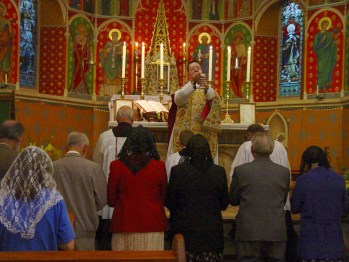
Some women have expressed to 'The Catholic Knight' a desire to return to the time honored custom of wearing the chapel veil during mass, and see the coming liturgical changes as a perfect opportunity to do this. Returning to this tradition will serve to further reinforce the message that the Catholic Church is the same today as it was yesterday, and the time honored customs of the Church have not died out, but on the contrary, live and breath through a new generation of Catholic women.

Sacred Scripture presents several reasons for wearing the chapel veil. St. Paul tells us in his first letter to the Corinthians (11:1-16) that Christian women must cover their heads because it is a Sacred Tradition commanded by our Lord Himself and entrusted to Paul: "The things I am writing to you are the Lord's commandments" (1 Cor. 14:37). "That is why a woman ought to have a veil on her head, because of the angels" wrote St. Paul (1 Cor. 11:10). The invisible hierarchy should be respected because the angels are present at all Christian assemblies during worship, offering the Holy Sacrifice with us according to the honor due to God. St. John the Apostle wrote: "And another angel came and stood before the altar, having a golden censer; and there was given to him much incense that he might offer it with the prayers of all the saints upon the golden altar which is before the throne." (Rev. 8:3, see also Matt. 18:10). They are offended by a lack of reverence at mass. The women of Corinth, beset by modern sensibilities, started coming to church without their heads covered. When St. Paul heard of their neglect, he wrote and urged them to keep the veil. According to St. Jerome's commentary Bible, he finally settled the matter by saying the head covering was a custom of the primitive communities of Judea, "the Churches of God" (1 Thess. 2-14, 2 Thess. 1-4) which had received this Tradition from early times (2 Thess., 2:15, 3:6). The “veil” represented modesty in many religions and cultures, especially in Judaism which was the cradle of the early Christian Church. A veil or head covering, is both a symbol and a mystical sacrifice that invites the woman wearing it to ascend the ladder of sanctity. When a woman covers her head in the Catholic Church it symbolizes her dignity and humility before God. It should not surprise us why so many modern women have so easily abandoned the tradition of the chapel veil (head covering) when the greatest meaning of the veil is modesty. It is purely an anti-Catholic culture that frowns on modesty. Do not be deceived, it was Secular feminism (a militantly anti-Catholic movement), that shunned Catholic women for wearing the chapel veil, telling them that a male dominated Church seeks to repress them. Such lunacy was nothing more than a lie straight from hell. If it were true, women would have been instructed to veil in the presence of men, but that is not the case at all. Both Sacred Scripture and previous canon law instructed women to veil in the presence of the Blessed Sacrament (not men), and particularly during the public prayer of the holy mass. The veil is a sign of modesty before our Eucharistic Lord. It is NOT a sign of male dominance. You can learn more about the custom of the chapel veil and what it means here.

'The Chapel Veil Campaign' is accompanied by a survey poll which can be viewed at the top of this blog. 'The Catholic Knight' requests that all you Catholic ladies out there review this material and prayerfully consider it. Then cast your vote in the accompanying poll to express your support for The Chapel Veil Campaign. Your vote of support will help other Catholic women muster the courage to do the same. The idea is to encourage young Catholic women all over the English-speaking world to put away the rebellion of the 1970s "hippy" generation, and start wearing the chapel veil again.

In the United States, the new English translation of the liturgy is currently scheduled to go into effect in Advent of 2011. That's because the US Catholic bishops no longer have permission from the Vatican to celebrate the "defective" English translation of the Novus Ordo mass we've been using since the 1970s. Since permission to celebrate it has been revoked, the US Catholic bishops will be unable to delay the transition anymore.

The return of the chapel veil, along with the liturgical renewal in the English translation of the mass, will send a clear and definite signal to the world that English-speaking Catholics have not lost the time-honored traditions of our sacred Catholic faith.

Please pass this message on by sending a Chapel Veil Campaign link to friends and family...
http://catholicknight.blogspot.com/2007/12/chapel-veil-campaign.html


'The Catholic Knight' welcomes your comments...

Related Stories...

Monday, January 12, 2009

Are You Shy About Wearing the Chapel Veil?

THE CATHOLIC KNIGHT: Since first posting on the subject of the chapel veil, 'The Catholic Knight' has received many emails from modest women who have expressed their desire to keep the Biblical custom, but simultaneously feel apprehension, embarrassment, or worry about the potentially negative reaction they may get from fellow parishioners. The common thread in all of these emails seems to center around not wanting to draw attention to one's self.

This is very commendable, because by not wanting to draw attention to one's self, the woman who veils demonstrates that she fully understands the purpose of what the veil is all about. A more recent email inspired me to post on this topic directly.

First and foremost, if you're a woman who fits the description above, know that you're not alone. Your desire to "not cause a scene" is commendable and demonstrates that you fully understand the purpose of the veil to begin with. That means of all people, you are probably the most ready to keep the custom.

Second, we often tend to associate the chapel veil with the pretty lace mantillas made popular in recent times by Traditional Catholics in the Extraordinary Form of the Roman Rite. Many of the beautiful veils are white, or some other stunning color, which do grab attention, especially if nobody else is veiled. Certainly there is nothing wrong with wearing such a lovely prayer cloth, but at the same time, it is not necessary either.

Third, to properly veil, women must understand the reason behind the chapel veil, and this can be found in 1st Corinthians 11. To review let me just outline some highlights of this custom...
  • The chapel veil (head covering for women) is a Christian custom that comes to us from the Scriptures (1st Corinthians 11).  Saint Paul outlined a deep theological purpose for keeping the custom that transcends all local and cultural reasons.  Therefore all Christian women are Scripturally encouraged, by Saint Paul himself, to keep the custom. 
  • The chapel veil was part of the code of canon law for centuries within the Catholic Church.  Under this canon, women were compelled to wear a head covering whether they wanted to or not.  The Church eventually decided that this custom had no place in canon law, and so it simply deleted that particular canon.  The Church DID NOT remove or reverse the custom itself.  It simply deleted the canon.  This made it so women could not be disciplined for refusing to wear the veil.  There is much debate as to whether this canon should have ever been part of the code to begin with.  As the Biblical instruction should be enough.
  • The chapel veil is a voluntary custom, but that doesn't mean it's optional.  By this I mean Christian women cannot ever be compelled to keep the custom against their will, but at the same time this does not mean it's okay for women (or anyone for that matter) to "pick and choose" which apostolic customs to keep and which to ignore.  The word "Catholic" means universal, complete and whole.  To be Catholic is to accept ALL of the customs of Christianity, not picking and choosing customs, as if Christianity where a salad bar.  The term "Cafeteria Catholic" is an oxymoron.  If one approaches Christianity with a "cafeteria" (pick and choose) mentality, one cannot be "Catholic" by the very definition of the word.  Catholic women should keep this in mind.  Refusing to wear a veil (head covering) in no way harms one's status in the Church, because women can no longer be disciplined for refusing to veil, now that the code of canon law no longer requires it.  However, it does reflect a mentality which "might" become potentially harmful to one's Catholic faith eventually. If one chooses to "pick and choose" on such a little thing as the chapel veil, it's not a far step from "picking and choosing" on other more important issues, such as artificial birth control, modest dress, gossip, complaining, mass attendance, regular confession, etc. etc. etc...  Please don't misunderstand, the chapel veil in no way "protects" women from these other issues, it's just that refusing to keep one apostolic custom, "could perhaps" lead to ignoring other more important customs.  Both men and women should consider this carefully.
  • The exact same Biblical regulation that commands women to cover their heads during prayer, is equally compelling upon men as well.  Don't think for one second that men are getting out of anything.  The same Scripture that commands the chapel veil for women also commands that men keep their heads uncovered during prayer.  That can sometimes be a burden to some men accustomed to wearing ball caps and hats all of the time.  The custom remains in place for men, even when prayer is done outdoors in the hot sun.  Men must remove their hats for prayer, even when the sun beats down on them, and even if their self conscience about their hair -- or lack thereof.  The clergy teach us by example.  A bishop always removes his mitre during various points of prayer in the mass.  A priest always removes his biretta before mass, (if he has one), and always puts it back on at the end of mass, just before leaving.
  • Christian veiling (head covering) is not the same as Muslim veiling (head covering) by any stretch of the imagination.  Those who make such accusations are ignorant of both faiths.  In Islam women are commanded to veil in the presence of men.  In Christianity women are only commanded to veil in the presence of the Lord.  Nowhere in the Bible can any command be found instructing women to veil in the presence of men.  It's just not in there.  Nor is there anything in the 2,000 years of Christian history and tradition in which women are instructed to veil in the presence of men.  That's because the presence of men has absolutely NOTHING to do with a Christian woman's veil.  The whole thing centers around God and God alone.  Men have nothing to do with it.  So Christian veiling and Muslim veiling have virtually nothing in common.
  • Nothing about the Biblical instruction to veil commands women to call attention to themselves either.  In today's western world, especially in English-speaking countries, the practice of the chapel veil has virtually disappeared from everyday Catholic life.  Only in the traditionalist communities does one still see the practice alive and well.  However, it doesn't have to be that way, and it shouldn't.  Many modest women, who want to keep the custom, are self conscious about what might happen if they attempt it.  This is truly a sad situation, but understandable.
There is more than one way to veil.  Keeping the custom doesn't have to mean drawing attention to one's self, and there are so many ways a woman can do it inconspicuously. Here are some suggestions...

Sit in the back of the Church, instead of the middle or front. Almost nobody will notice you there, and the only way you can draw attention is if people actually turn around to look at you. That is not likely to happen. So the back of the church is a good place to start.

The most simple way to keep the custom is with a hat.  Below we have an example of a simple beret.  It's cute and fashionable, but at the same time doesn't stand out much.  In this case below, the beret actually matches this woman's outfit quite nicely.  Many people would probably be unaware she is even keeping the apostolic custom of 1st Corinthians 11....


Another way to keep this custom is with a simple scarf or shawl. It doesn't have to be brightly colored or ornate.  In fact, it's probably better if it's not.  This can be worn around the neck or over the shoulders when entering the church, inconspicuously, as you seat yourself in the back of the church quietly, outside of most people's view.  This young woman below gives us an example with a warm shawl she wore on a cold day.  Thin light weight shawls could similarly be used on warm days...


Then, when upon kneeling for prayer, or when mass begins, the scarf or shawl can simply be lifted up over the head without anyone noticing...


After mass is over, while the priest is recessing back down the isle, the scarf or shawl can be dropped back down over the shoulders before everybody leaves. Thus the woman who does it this way can exit the chapel the same way she came in, with most people being completely unaware of her keeping the Biblical custom.

There is only one time when there would be an exception, and that is during communion. When for a brief time you would be at the front of the church instead of the back. However, when this happens, everyone's eyes are supposed to be downcast and contemplating the real presence of the Lord. If there are people in the pew staring at you, than SHAME ON THEM, not you. You didn't do anything to attract their attention, they are supposed to be contemplating the Lord. The only person who is supposed to look at you is the priest, or the Eucharistic minister, and those people are supposed to be knowledgeable of the veiling custom and not judgemental about it.  Again, you've done nothing to attract attention to yourself.

In almost every case where woman have actually kept the custom, they report to me that they were surprised how little reaction they got all together. They were expecting more, either positive or negative, and what they got was nothing -- literally nothing. It's as if the vast majority of people there didn't care, and most of them didn't even notice. If you're shy, or self conscious about keeping the Biblical custom of veiling, you may want to keep this in mind. Chances are you're far more conscious of it than those around you.

There have been rare cases (very rare) when veiled women have been confronted by other women who disapprove of this practice. If by rare happenstance this happens to you, know that you've done absolutely nothing wrong, and the woman confronting you is acting in an uncharitable, and dare I say unchristian, sort of way. There are people like this. They're called feminists, and they've embraced a philosophy and mindset that opposes the church on so many levels. Often these very same women advocate artificial birth control, believe women should become priests, and think of the male Catholic hierarchy in a negative way. They'll sight all sorts of erroneous reasons why women should no longer veil. If you should find yourself in this rare and unlikely circumstance, here is the proper response...
  1. Smile
  2. Then say: "You know, I would never try to force my own personal views on another parishioner."
  3. Then tell her: "And it's really none of your business how I choose to reverence the Lord."
  4. End with; "God bless you."
  5. Then walk away.
If you handle it this way, you can be assured that your reward in heaven will be great.  You've just received a bit of persecution for reverencing the Lord, and you handled it with charity and civility.  Meanwhile, the feminist woman who harassed you will be looking very foolish at this point.

If on the EXTREMELY RARE chance that a man actually confronts you over wearing the veil, and I've never heard of this happening, the way to deal with it is virtually identical....
  1. Smile.
  2. Tell him: "You know, I would never try to force you to wear a hat during mass."
  3. Then say: "And it's really none of your business how I choose to reverence the Lord."
  4. End with: "God bless you."
  5. Then walk away.
I only outline these responses to be thorough. In all reality you will probably never be confronted with ANY of these situations. Of course there are always those who might have honest and sincere questions about the chapel veil, simply because they don't know anything about it.  You are far more likely to run across someone like this. If anyone asks you for a reason why you wear the chapel veil, simply cite 1st Corinthians 11 and leave it at that.  If someone sincerely wants more details, direct them to this website.

Related Stories...

Wednesday, May 28, 2008

Feminist Bullies In The Catholic Church

THE CATHOLIC KNIGHT: A dear Catholic sister recently commented on this blog, stating her intention to wear the chapel veil after her daughter is born this summer. She said it was after reading this blog, talking with her husband, and much prayer, that she was able to overcome the peer pressure against the chapel veil in her parish. I responded in support of her decision as follows...
As you can see by the poll at the top of every page on this blog, the chapel veil is supported by the overwhelming majority of Catholics - both men and women (approx. 56%). While about 5% are unsure on the matter, a small minority of just 34% are dead set against it. (I assume these are mostly feminists, and are probably older women.)

However, because of this mere 34%, the overwhelming majority of Catholic women (nearly all), in the English-speaking world, no longer practice veiling. Why? Because they're afraid. They're afraid of what others will think. Yet I've proved on this blog that those who disapprove are a small (albeit loud) minority. They are vastly outnumbered by those who do approve.

This is what we call "the tyranny of the minority." It's when a small group of people are able to control an entire population simply through peer pressure. That's what's going on here. A small minority of "feminist" Catholic women are coercing nearly all Catholic women, by means of peer pressure. They do it by being loud and obnoxious. Put on a veil, and they jump all over you.

That's just WRONG, plain and simple. It's a form of bullying, and it violates what the Bible says on the matter. This small minority of women, are not only behaving as bullies, but their borderline heretics, because in pressuring women to remove the veil, they violate the plain teachings of Scripture on the matter.

I put the chapel veil poll at the top of every page on this blog so women who want to veil will see that they have nothing to fear. Those who support them are in the MAJORITY - a large majority. Only a very tiny minority oppose them, and they do so in violation of Scripture.

Women who wish to veil must take courage. They must understand that they're doing the right thing. And most importantly, they must understand that the few women who oppose this are not only a tiny minority, but they're acting as bullies and heretics when they do so.

It's time for Catholic women to be strong. It's time for them to stand up to tyranny. How dare any woman pressure another to ignore the plain teachings of Scripture on this matter! If that tiny minority wants to refuse the veil, then so be it. Nobody is making them wear one, and nobody is ever going to. But how dare they try to pressure another woman to refuse the veil. Who do they think they are!?!
Let it be known from this time forth that 'The Catholic Knight' will boldly defend the right of any Christian woman (Catholic or otherwise) to veil for prayer and worship. Furthermore, I call upon all Christian men (Catholic or otherwise) to boldly and passionately defend their wives and daughters who make a similar decision. Our women are being bullied by a tiny feminist minority that is hell-bent on peer pressuring them to ignore the plain teachings of Scripture on this matter. A call goes forth from here to all Christian men - "Be a man, and defend your women against the tyranny of the minority."

Related Stories...

Saturday, December 22, 2007

The Chapel Veil - Veiling or Head Covering - Fully Explained

Chaldean Catholic Women Attend Sunday Mass

THE CATHOLIC KNIGHT: Unfortunately, something as simple as a chapel veil has become somewhat of a controversy in the modern Catholic Church. To be more accurate, it's not so much a controversy in the "modern" Catholic Church as it is in the "western" Catholic Church, particularly in English-speaking nations. One would not find so much of a controversy if one were to visit a Catholic Church in the third world. There one would find the chapel veil used by many Catholic women almost universally. Eastern Orthodox women also veil in these regions. While here in the western industrialized world, eastern Orthodox women (along with eastern Catholic women in the Byzantine Rite) have kept the custom a bit more faithfully than western Catholic women in the general Roman Rite. Yes, veiling in some form was even common in most Protestant communities for many centuries prior to the 1960s. In some Protestant groups the custom evolved into large elaborate hats, which one can still see practiced in the Methodist Episcopal denomination. The custom is also still practiced in the form of lace mantillas and/or bonnets among the Amish, Mennonites, the Apostolic Christian Church, some Pentecostal groups, which includes the 'Church of Our Lord Jesus Christ of the Apostolic Faith,' and the stricter Dutch Reformed churches. Though most Protestant denominations have no official expectation that women veil, some individual ladies choose to practice the custom according to their understanding of 1st Corinthians 11.

The chapel veil was the custom of all Catholic churches (eastern and western), everywhere in the world (including English-speaking nations) for nearly 2,000 years. The custom only fell out of use among western Catholic women, particularly in English-speaking nations, in just the last 30-40 years. Why is that?

A movement was introduced to western culture at around the same time that explains a lot of it. The movement was called feminism. Like most social movements born in the 1960s, some good did come out of it. But at the same time, some not-so-good things came out of it. On the positive side, feminism pushed for equality for women in the workplace and in government. On the negative side, feminism saddled women with burdens they never bargained for, and in some ways made their struggle worse than it was before. The long term effects of feminism (positive and negative) will be debated for decades to come, and that is not the purpose of this article. So for now, we'll leave the sociology to the sociologists.

What concerns us is feminism's effect on Catholic women in western cultures, particularly those in English-speaking nations. The most noticeable effect in such nations was the rapid disappearance of the chapel veil from mass. Almost overnight the veil was gone. This was accompanied by the release of the new Code of Canon Law in 1983, which no longer mentioned chapel veils. Since the new Code of Canon Law abrogated the older code, it was assumed by many that the custom of veiling was also abrogated, simply because it was no longer mentioned. That combined with feminist influences on Catholic women in western nations led to the popular misconception that veiling is now optional, and women are no longer required to do it. As a result, it came to be the norm for older traditional women to keep wearing the veil, while younger Catholic women discarded it completely.

The feminist transformation of western Catholic women was accomplished mainly though propaganda. It was propaganda that fit the feminist mindset very well, but actually mischaracterized and falsely represented the Catholic mindset. Women were told that the veil represented male oppression, and that a male controlled Catholic Church sought to dominate women by forcing their subjection through the symbolic act of veiling while in Church. (Now none of this is true, and if it were, yours truly would be against the chapel veil as well.) The tide of feminism was overwhelming in western culture, particularly in English-speaking nations, and as a result most Catholic women simply accepted this propaganda as truth without ever questioning it. Thirty years have gone by, and one can easily find Catholic women who still accept the propaganda without question, having never even heard a rebuttal.

It would appear the Vatican listened to the feminist movement, and did find a potential problem in the Code of Canon Law that could be made as a case to bolster the erroneous feminist argument. It was possibly for this reason the Vatican dropped the chapel veil requirement from the Code of Canon Law. Under the old Code of Canon Law, women could theoretically be forced under penalty to wear a chapel veil against their will. The problem with this was twofold. First, this canon could be used as a case to bolster the erroneous feminist argument against the chapel veil. Second, this canon actually defeated the authentic Catholic reason for veiling in the first place.

The authentic Catholic reason for wearing the chapel veil is the Biblical reason. It's just something that all Christian women (regardless of denomination) are supposed to do, not because they have to, but because they're supposed to want to. The Catholic Church has decided to no longer enforce this Biblical custom through Canon Law, and in doing so, the Church is saying it does not want to be our nanny. The chapel veil is a custom for women to do voluntarily, because they want to, not because they are being forced to. The idea is that women are to read what the Scriptures have to say, and be convicted according to what is contained therein. In order for a chapel veil to be an authentic sign of humility and holiness, it must be voluntary. Indeed, Christian women are supposed to wear one, but it is never to be forced.

The Scriptural case for the chapel veil...
1st Corinthians 11:2-16
I commend you because you remember me in everything and maintain the traditions even as I have delivered them to you...
The tradition of the chapel veil comes from Christ, by way of the Holy Spirit, through St. Paul, for Paul mentions later in this same epistle: "What I am writing to you is a command of the Lord. If any one does not recognize this, he is not recognized." - 1st Corinthians 14:37-38 St. Paul commends the Corinthians for keeping the chapel veil tradition, among other traditions, and then he continues in chapter 11...
....But I want you to understand that the head of every man is Christ, the head of a woman is her husband, and the head of Christ is God...
Here we have the central point of misunderstanding. This verse has been misused time and time again as a means of male superiority. Not only is this a misreading of the text, but it completely misses an important theological point Paul is trying to make. This chapter of Corinthians is entirely Eucharistic, in the sense that it centers around the Eucharistic celebration (or the mass). The following verses (17-34) deal entirely with the celebration of Holy Communion. When Paul says the head of every man is Christ, what he's saying is that Christ came in the form of a man. He's making a statement about the incarnation. He's saying that Christ came in human form, and because of this, the man becomes a physical representation of Christ -- particularly if he is a husband. When he says the head of every woman is her husband, he is not saying that women are inferior to men in any way. What he's saying is that if a husband becomes the physical representation of Christ's incarnation, than his wife becomes the physical representation of Christ's spouse -- or the Church. When Paul says "husband" here, he is referring both to earthly husbands, and to Christ himself. That being the case, wives take on the symbolic role of the Church. Paul continues in chapter 11...
...Any man who prays or prophesies with his head covered dishonors his head, but any woman who prays or prophesies with her head unveiled dishonors her head...
Again, this goes straight back to the incarnation. All of this is a symbol of what we Catholic Christians believe about Christ, his incarnation, and the Eucharist. Paul tells us that if a man covers his head during mass, he dishonors his spiritual "head" which is Christ. In other words, a man who covers his head during mass dishonors Christ, because his action of veiling himself sends the physical statement that Christ was not incarnate as a man. The woman, on the other hand, representing the Church, ought to cover her head because if she believes that Christ is truly incarnate, she should veil herself as a sign that the Church has been made holy by Christ as his spouse. In doing so she honors Christ as a symbol of his sanctification on the Church. She also honors her husband with a physical sign that he represents Christ, because Christ came in the form of a man. The chapel veil is a sign of holiness because Christ has made his Church holy, and women represent the Church as the "bride" of Christ. It is a sign that the Church is covered and under Christ's protection. This is the symbolism of the Church's relationship to Christ. It is not so much a statement of a particular woman's holiness, but rather the Church's holiness. Paul continues...
-- it is the same as if her head were shaven. For if a woman will not veil herself, then she should cut off her hair; but if it is disgraceful for a woman to be shorn or shaven, let her wear a veil...
Here Paul is really laying it on think, and he has good reason. He's trying to convey a big theological point. Customs in the church are not the result of random happenstance. These things exist for a reason. Under the Old Covenant, both Jewish men and women covered their heads during worship, but the early Jewish Christians changed that custom for a reason. They wanted to make this practice of veiling a symbol of Christ's incarnation, like they did with so many other Jewish traditions, and as Paul mentions in chapter 14 (cited above) these things are not trivial man-made customs, they came from the Holy Spirit Himself. Here Paul is telling us that it is shameful for a Christian woman not to cover her head during mass, and he is using an illustration from antiquity that has to do with punishment. In ancient times, women would have their heads shaved publicly as punishment for lack of modesty. It was a form of public humiliation. Here Paul is not advocating the shaving of a woman's head for refusing to wear the chapel veil, but rather, he is trying to convey the seriousness of the imagery. When a Christian woman refuses to do this, she is in effect saying (though perhaps not intentionally) that Christ was not incarnate in the form of a man. Granted, in modern times this is almost certainly not the intention of any woman who refuses to veil during mass, but what Paul is telling us here is that every custom in the Church has meaning, and because of that, failure to keep those customs also has meaning, whether one intends to convey that meaning or not. It's sort of like bowing, kneeling or genuflecting before the Eucharist for example. Catholics do these things in mass for a reason, and that reason is to stress the real presence of Christ in the blessed sacrament. In practice, we are bowing, kneeling and genuflecting before our God and King, whom we profess to be really and truly present in the sacrament of the Holy Eucharist. That being the case, if one fails to bow, kneel and genuflect, what kind of signal does that send to those around him/her? One may not intend to send any signals of disrespect, but invariably one can, whether one intends to or not. The custom of the chapel veil has similar significance. Paul continues....
...For a man ought not to cover his head, since he is the image and glory of God; but woman is the glory of man. (For man was not made from woman, but woman from man. Neither was man created for woman, but woman for man.) That is why a woman ought to have a veil on her head, because of the angels....
Here we have another commonly abused passage. Again, Paul is not trying to bolster male dominance here. Remember, we have to keep the context of this chapter in mind, and the context of 1st Corinthians 11 is the Eucharistic celebration. Paul calls man the "image and glory of God" for one reason and one reason only -- because Jesus Christ (who is God) was made incarnate as a man. Then he expounds on this by pointing out that the woman is the "glory of man" (or mankind). This is meant to be a complement. Of the two human genders, women are far more "glorious" then men in their appearance, beauty, voice, fashion and general gracefulness. The hair was considered a woman's crowing glory in Biblical times (Song of Songs 6:5). Beyond that, women bear the special gift of motherhood. In that, God touches them in a way no man has ever experienced. The Scriptures tell us that God Himself fashions the unborn child in the womb, and plants a living human soul inside the body of a women when she becomes pregnant (Psalm 139:13-16). In this way, God touches the body of a woman in a way he never touches a man's body. This makes the woman's body a sacred vessel of God's creative powers. It is something that is particularly holy, and must be respected as such. It is no wonder why women are called the "fairer sex." Paul is agreeing with that here. However, Paul is also reminding women not to get too prideful. He reminds them of the Biblical story of Adam and Eve, where the woman is made to complement the man, and not vice versa. Now we learn that the chapel veil is also a sign of personal humility in addition to the Church's holiness. The woman not only covers her head as a sign of her belief in a incarnation, not only to show how Christ has made his Church holy, but also to cover her "glory," as a sign of humility to show that she is not vain or overly proud of her womanhood and beauty. The veil or headcovering is a symbol of the woman's acceptance of her role in society, the family, and the Church, in accordance with God's will. It is an imitation of the Virgin Mary, who wore such a headcovering.

Then St. Paul says something very curious. He says the woman ought to veil her head during mass "because of the angels." Paul tells us that the angels participate with us during mass, and this is reinforced by the writings of St. John: "And another angel came and stood before the altar, having a golden censer; and there was given to him much incense that he might offer it with the prayers of all the saints upon the golden altar which is before the throne." (Revelation 8:3, see also Matt. 18:10). The angels watch everything that is going on during mass, as they participate in the same liturgy we do. They are also well aware of the customs of the Church and what they mean -- even the custom of veiling. Angels are offended when we ignore or refuse to follow any liturgical custom, whether it be failing to kneel or veil in the presence of our Eucharistic Lord.
...(Nevertheless, in the Lord woman is not independent of man nor man of woman; for as woman was made from man, so man is now born of woman. And all things are from God.)...
If ever there was a verse to counter the abuse of male dominance, this is it. If ever there was a verse to prove that St. Paul was not a male chauvinist, this is it. Paul follows his previous verse, reminding women to be humble, with this verse, reminding men to be humble too. He doesn't want the men to use what he just wrote as a means of beating down the women in a form of male superiority. He is reminding the men that they are not superior to the women, but rather fully dependent on them, and that both genders come from God. One cannot be "better" than the other. Then he continues with some rhetorical questions to back his point...
...Judge for yourselves; is it proper for a woman to pray to God with her head uncovered? Does not nature itself teach you that for a man to wear long hair is degrading to him, but if a woman has long hair, it is her pride? For her hair is given to her for a covering....
Paul is not prohibiting hair styles here. To focus on hair styles is to miss the point. Paul is simply asking a few rhetorical questions based on popular culture. In most cultures women have longer hair then men, and when they do, it usually looks better. He's saying that when a woman has long hair it usually looks beautiful, and when a man has long hair, it usually looks a little odd. In some cultures, long hair is considered a sign of femininity. So if a man has long hair, it looks feminine in those cultures, and that is "degrading" to him. What Paul is doing here is he's appealing to nature. He's saying; "Look, even mother nature teaches us the same lesson. She gives women long hair as a covering and it looks good and proper on them." Then he concludes with this interesting verse...
...If any one is disposed to be contentious, we recognize no other practice, nor do the churches of God.
Some Bible versions have mistranslated this verse to say "we recognize no such practice, nor do the churches of God." This mistranslation is often used to negate the previous first half of the chapter. In other words, those who abuse such mistranslations say that Paul spent half a chapter, explaining a deep theological principle pertaining to a custom he applauds the Corinthians for keeping, only to say in this last verse that they really don't need to keep it. Such interpretations are silliness. The proper translation is rendered here as "we recognize no other practice." Here Paul is telling the Corinthians not to get too contentious over the chapel veil custom, because he's not going to burden them with anything else beyond that. He's not going to tell men and women how to dress. He's not going to tell them what kind of a veil they should wear, or how they should wear it. He's simply saying that this is the custom as it is practiced in the "churches of God" and they recognize no other practice beyond this.

So the chapel veil has nothing to do with male dominance. It has nothing to do with subjecting women under male authority. It has everything to do with Christ's incarnation, and the real presence of our Lord in the Blessed Sacrament.

The Bible is very clear about this. Women are supposed to veil in the presence of the Eucharist and in prayer, but at the same time, they are to take it upon themselves to do it. They are not to be forced into it by men, nor coerced into it by the Canon Law of the Church. Coercion actually defeats the whole purpose of veiling. (Which may be one reason why the custom of the veil has no place in canon law.) It has to be voluntary, if it is truly to be a sign of holiness and humility. This is why the Church removed it from Canon Law. It was not to send a signal to women that they need not do it anymore. Rather, it was to tell women that when they veil themselves, it is not because men told them to. It is a sign and symbol coming from them, voluntarily, not as a grudging requirement against their will.

Furthermore, the chapel veil is a sign of the incarnation, illustrated in the presence of the Blessed Sacrament. Women are supposed to veil in the presence of the Sacrament and in prayer before God. They are not veiling in the presence of men, nor has the tradition of the Church ever required this. The feminist propaganda was wrong. If the chapel veil were a sign of male dominance, than it would have been required in the presence of men, but it is not. Nowhere in Church history, Canon Law, or the Bible, are women required to veil in the presence of men. They are only expected to veil in the presence of our Lord.

Though the custom has generally lapsed in western cultures, particularly English-speaking nations, it is not erased entirely from the conscience of western Christians. For example; what's the first thing a Catholic mom does when her daughter is preparing for first communion and confirmation? She goes out and buys a veil. Likewise, what's one of the most important accessories to a bridal gown? Why it's the veil of course! Finally, when a baseball game or community event is opened in prayer, regardless of the religious denominations of those in attendance, what's the first thing everybody does? The men all remove their hats, and the women do not. Funny how that works, isn't it. This doesn't just happen by accident. It all goes back to the ancient Christian custom of veiling.

Yes, Christian women are supposed to veil during worship, and this is especially true for Catholic women who understand the incarnation of Christ and His real presence in the Blessed Sacrament. According to the Bible, this is not optional. All Christian women are expected to do it, but it is to be done voluntarily, without force or coercion. The custom was removed from the Canon Law of the Catholic Church, but it was never abrogated as a Biblical custom of the Faith. To veil properly, women must do so voluntarily, and they must do so with proper understanding of the custom and what it means. Hopefully this article has been helpful in this.

Related Stories...

Sunday, July 22, 2007

Wearing The Chapel Veil


THE CATHOLIC KNIGHT: It is revealing when one considers how Catholic women all over the world still keep this custom. Unveiled women during mass is a phenomenon mostly seen in the West -- particularly English speaking nations. In a way, we could consider this custom a barometer of sorts. A society's Liberal decadence can be measured in part by how few women veil themselves during mass...
Derived from a book in progress called: "The Unveiled Woman"
by Jackie Freppon

During the second Vatican Council, a mob of reporters waited for news after a council meeting. One of them asked Msgr. Annibale Bugnini, then secretary of the Vatican Congregation for Divine Worship, if women still had to wear a headcover in churches. His response was that the Bishops were considering other issues, and that women's veils were not on the agenda. The next day, the International Press announced throughout the world that women did not have to wear the veil anymore. A few days later, Msgr. Bugnini told the press he was misquoted and women still had to wear the veil. But the Press did not retract the error, and many women stopped wearing the veil out of confusion and because of pressure from feminist groups.

Before the revision in 1983, Canon law had stated that women must cover their heads ". . . especially when they approach the holy table" (Can 1262.2). But in order to reduce such a growing collection of books, the new version of Canon law was subjected to concise changes. In the process, mention of headcoverings was omitted. In 1970, Pope Paul VI promulgated the Roman Missal, ignoring mention of women's veils. But at the time the Missal was published, it didn't seem necessary to keep mandatory such an obvious and universal practice, even if it no longer had a "normative" value (Interinsigniores, #4). And mention in Canon law or the Roman Missal is not necessary to the continuation of the tradition, for it is rooted in Scripture and has been practised ever since the early Church. Indeed, Pope John Paul II affirmed that the real sources of Canon law are the Sacred Tradition, especially as reflected in the ecumenical councils, and Sacred Scripture (O.S.V. Catholic Encyclopedia, p. 169).

SCRIPTURE
Sacred Scripture presents several reasons for wearing the veil. St. Paul tells us in his first letter to the Corinthians (11:1-16) that we must cover our heads because it is Sacred Tradition commanded by our Lord Himself and entrusted to Paul: "The things I am writing to you are the Lord's commandments" (1 Cor. 14:37).

DIVINE HIERARCHY
God has established a heirarchy, in both the natural and religious spheres, in which the female is subject to the male. St. Paul writes in first Corinthians: "But I would have you know that the head of every man is Christ, and the head of the woman is man, and the head of Christ is God (1 Cor. 11-3). And, in the institution of marriage, God gave the husband authority over the wife, but responsibility to her as well. Not only is he the family's decision-maker, but he is also responsible for the material and spiritual welfare of his wife and children. Man is not in this position to enslave or belittle the wife. As the Bride, (the Church), is subject to Jesus, women must wear the veil as a sign that they are subjected to men: "Let wives be subject to their husbands as to the Lord; because a husband is head of the wife, just as Christ is head of the Church." (Eph. 5, 22-23). The man represents Jesus, therefore he should not cover his head. However, this subjection is not derogatory to women, because in God's kingdom everyone is subjected to a higher authority: "For as the woman is from the man, so also is the man through the woman, but all things are from God." (1 Cor. 11, 12). Furthermore, the symbolism of the veil takes that which is invisible, the order established by God, and makes it visible. In the history of the Church, priestly vestments have played a similar symbolic role.

WOMEN'S HONOR
It is an honor to wear the veil. But by publicly repudiating it, a woman dishonors her feminine dignity, the sign of female subjection, just as the military officer is dishonored when he is stripped of his decorations. The Roman Pontifical contains the imposing ceremonial of the consecration of the veils: "Receive the sacred veil, that thou mayst be known to have despised the world, and to be truly, humbly, and with all thy heart subject to Christ as his bride; and may he defend thee from all evil, and bring thee to life eternal" (Pontificale Romanum; de benedictione). St. Paul says an unveiled woman is a dishonor: "But every woman praying or prophesying with her head uncoverd disgraces her head, for it is the same as if she were shaven" (1 Cor. 11, 5).

BECAUSE OF THE ANGELS
"That is why a woman ought to have a veil on her head, because of the angels" wrote St. Paul in 1 Cor. 11, 10. The invisible heirarchy should be respected because the Angels are present at Christian liturgical assemblies, offering with us the Holy Sacrifice with the honor due to God. St. John the Apostle wrote: "And another angel came and stood before the altar, having a golden censer; and there was given to him much incense that he might offer it with the prayers of all the saints upon the golden altar which is before the throne." (Rev. 8:3, see also Matt. 18:10). They are offended by a lack of reverence at Mass, just as they abhorred King Herod's acceptance of adoration from the people of Jerusalem: "But immediately an angel of the Lord struck (Herod) down, because he had not given honor to God, and he was eaten by worms, and died." (Acts, 12:23).

ANCIENT TRADITION
The custom of wearing the veil was maintained in the primitive Churches of God. (1 Cor. 11:16). We see this in the first letter of Paul to the Corinthians. The women of Corinth, beset by modern sensibilities, started coming to church without their heads covered. When St. Paul heard of their neglect, he wrote and urged them to keep the veil. According to St. Jerome's commentary Bible, he finally settled the matter by saying the head covering was a custom of the primitive communities of Judea, "the Churches of God" (1 Thess. 2-14, 2 Thess. 1-4), which had received this Tradition from early times (2 Thess., 2:15. 3:6).

GOD'S COMMAND
Even today some people erroneously believe that St. Paul based the tradition on his personal opinion. They think he did not intend it to be continued in the Universal Church, but only as a local custom. This argument, however, does not conform to the Pauline spirit. After all, it was Paul who stood before Peter to change Jewish traditions in Christian Churches (Gal. 2:11-21). St. Paul reminds them: "for I did not receive it from man, nor was I taught it; but I received it by a revelation of Jesus Christ" (Gal. 1:12), referring to the authority of his ministry, and veracity of his words. Pope Linus, who succeeded St. Peter, enforced also the same tradition of women covering their heads in the church (The Primitive Church, TAN). Our Lord warns us to obey His commandments: "He therefore that shall break one of these least commandments, and shall so teach men, shall be called the least in the kingdom of heaven" (Matt. 5:19).

CONCLUSION
In summary, the reasons that St. Paul advises women to cover their head in the church are:

  • Our Lord commanded it;
  • It is a visible sign of an invisible order established by God;
  • The Angels at Mass are offended if women don't use it;
  • It is a ceremonial vestment;
  • It is our heritage.

Christian women around the world have other reasons to wear a hat, mantilla, rebozo, gele, scarf, shawl or veil. Some wear it out of respect to God; others to obey the Pope's request, or to continue family traditions. But the most important reason of all is because Our Lord said: "if you love Me, keep My commandments" (John 14:15). We should always be ready with our bridal veils, waiting for Him and the promised wedding (Apoc. 22:17), following the example of our Blessed Mother, Mary, who never appeared before the eyes of men but properly veiled. To those who still think that the veil is an obsolete custom, remember that: "Jesus Christ is the same, yesterday and today, yes, and forever" (Heb. 13:8).

source

Related Stories...

Wednesday, November 15, 2006

Younger Nuns Are Getting Back Into The Habit

By TRACY SCHMIDT, LISA TAKEUCHI CULLEN

For the iPod generation, it doesn't get more radical than wearing a veil. The hijab worn by traditional Muslim women might have people talking, but it's the wimple that really turns heads. And in the U.S. today, the nuns most likely to wear that headdress are the ones young enough to have a playlist.

Over the past five years, Roman Catholic communities around the country have experienced a curious phenomenon: more women, most in their 20s and 30s, are trying on that veil. Convents in Nashville, Tenn.; Ann Arbor, Mich.; and New York City all admitted at least 15 entrants over the past year and fielded hundreds of inquiries. One convent is hurriedly raising funds for a new building to house the inflow, and at another a rush of new blood has lowered the median age of its 225 sisters to 36. Catholic centers at universities, including Illinois and Texas A&M, report growing numbers of women entering discernment, or the official period of considering a vocation. Career women seeking more meaning in their lives and empty-nest moms are also finding their way to convent doors.

This is a welcome turnabout for the church. As opportunities opened for women in the 1960s and '70s, fewer of them viewed the asceticism and confinements of religious life as a tempting career choice. Since 1965, the number of Catholic nuns in the U.S. has declined from 179,954 to just 67,773, according to the Center for Applied Research in the Apostolate at Georgetown University. The average age of nuns today is 69. But over the past decade or so, expressing their religious beliefs openly has become hip for many young people, a trend intensified among Catholic women by the charismatic appeal of Pope John Paul II's youth rallies and his interpretation of modern feminism as a way for women to express Christian values...

read full story here
Related Stories...

Tuesday, September 12, 2006

Wear Your Mantilla with Pride!


Why Wear the Veil?

In ancient traditions dating back even thousands of years, the “veil” represented purity and modesty in many religions and cultures. A veil, or head covering, is both a symbol and a mystical sacrifice that invites the woman wearing it to ascend the ladder of sanctity.

When a woman covers her head in the Catholic Church it symbolises her dignity and humility before God, not men. It is no surprise women of today have so easily abandoned the tradition of the chapel veil (head covering) when the two greatest meanings of the veil are purity and humility.

The woman who covers her head in the presence of the Lord Jesus in the Blessed Sacrament is reminding herself that she must be humble before God. As with all outward gestures, if it is practised enough it filters down into the heart and is translated into actions that speak volumes. The “veil” covers what the Lord calls, in Holy Scripture, “the glory of the woman”, her hair. Covering her hair is a gesture the woman makes spiritually to “show” God she recognises her beauty is less than His and His Glory is far above hers.

In doing this she is reminded that virtues cannot grow in the soul without a great measure of humility. So she wears the veil to please God and remind herself to practice virtue more ardently.

There is no other piece of clothing a woman may wear to serve this function. The veil symbolically motivates the woman to “bow” her head in prayer, to lower her eyes before the great and mysterious beauty and power of God in the Blessed Sacrament. By the bowing of her head and lowering of her eyes, she is more able to worship God in the interior chapel of her heart and soul.

The veil or head covering a woman wears gives a beautiful sense of dignity to a woman. When she wears it, she identifies herself with God’s greatest creation, the Blessed and Immaculate Virgin Mary, Mother of God. There was none on earth that loved and loves the Lord Jesus more than the Blessed Virgin Mary. In her love, her humility breathed forth like sweet scented incense before God. The veil she wore symbolised her purity, modesty and of course her profound humility and submission before and to God Almighty.

Those women who love Jesus must come to realise the imitation of His Mother in wearing a chapel veil (head covering) and in other virtues is a small sacrifice to make in order to grow in spiritual understanding of purity, humility and love.

The covering of a woman’s head in Church is a striking reminder of modesty, something old but lost in the society of today. Modesty and purity walk hand in hand.

When a woman veils her head she is shielding her heart to be wooed by the love of God in the Blessed Sacrament. This is a mystical ‘country’ that only the Eternal Father may enter. Her veil is like the lighted lamps of the virgins waiting for the Bridegroom, an indication that she is prepared to receive Him at a moment’s notice; an aureole of her spiritual love for the Bridegroom. Wearing the veil is an act of love of God.

Why should a woman wear a head covering or veil in church? Not to be praised, not to go along, not for tradition’s sake, not to stand out in the crowd, not because you say or I say or anybody says…But because she loves our Eucharistic Lord Jesus and it is another small sacrifice she may offer for her soul’s sake and for the sake of many souls who have no one to offer for them. Amen.

(Sr Patricia Therese, OPB)

Marylike Standards of Modesty in Dress

  1. Marylike is modesty without compromise, “like Mary”, Christ’s Mother.
  2. Marylike dresses have sleeves extending at least to the elbows (because of impossible market conditions quarter-length sleeves may be tolerated temporarily) and skirts reaching below the knees, even when seated.
  3. Marylike dresses require full coverage for the bodice, chest, shoulders and back, except for a cut-out about the neck not exceeding two inches below the neckline in front and in back, and a corresponding two inches on the shoulders.
  4. Marylike dresses do not admit as modest coverage transparent fabrics – laces, nets, organdy, nylons, etc. – unless sufficient backing is added. However, their moderate use as trimmings is acceptable.
  5. Marylike dresses avoid the improper use of flesh-coloured fabrics.
  6. Marylike dresses conceal rather than reveal the figure of the wearer; they do not emphasise, unduly, parts of the body.
  7. Marylike dresses provide full coverage, even after jacket, cape or stole are removed.

Marylike clothing is designed (as is inherent in the very definition) to clothe the body, not to reveal it. These guidelines, therefore, automatically exclude such fashions as tight sweaters and skirts, sheer blouses and sleeveless dresses. Note that, contrary to the vogue of the last fifty years, men’s attire is not appropriate for women and girls who emulate the modesty and purity of Our Blessed Mother in their dress and demeanour.

Marylike standards of dress are a guide to help instil in the hearts and souls of our youth a “sense of Christian modesty”, that beautiful fruit and flower of holy purity, the awareness of one’s integrity as a Child of God. A young woman who follows these guidelines, and who looks up to Our Lady as her ideal and model in all things, will have no problem with modesty in dress. She will never be an occasion of sin or source of embarrassment or shame to others. On the contrary, she will realise in herself the prayer of so many young women who have taken Our Lady for their model and mother: “May all who see me, see thee, O Mary!”

[Taken from the Latin Mass Society's November 2003 Newsletter.]
source

Related Stories...