Showing posts with label Latin. Show all posts

Saturday, May 22, 2010

An Interview With Fr. Jeffery Fasching

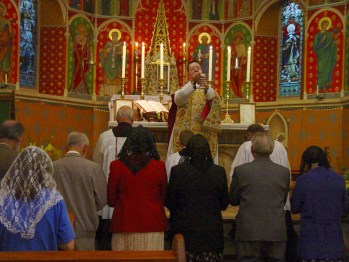
Bishop James V. Johnston assists Father Jeffery Fasching during
the Traditional Latin Mass at St. Agnes Cathedral in Springfield Missouri.
Sunday, May 9th 2010

THE CATHOLIC KNIGHT: The following is an exclusive interview of Father Jeffery Fasching by The Catholic Knight (TCK). It is a followup to his article entitled Young Priest Discovers Renewal In Old Rite. Father Jeff Fasching serves as pastor for the Latin Mass Community at St. Agnes Cathedral in Springfield Missouri.

--------------------
TCK: Father Fasching, first I want to thank you for your service to the Church and for granting this interview. It is a pleasure and an honor to share this time with you.

Fasching: You're very welcome for the interview. It is my pleasure to have the opportunity to address some questions regarding the Holy Sacrifice of the Mass. I am truly humbled that you have taken an interest in the ministry God has bestowed upon me.

TCK: In your article you indicated a general renewal in your approach to the liturgy and the eucharist by learning the traditional Latin mass, also known as the "Tridentine," Extraordinary Form and Usus Antiquior (or "ancient use") mass. Would you like to elaborate on this?

Fasching: I indicated in my previous article that I have experienced somewhat of a "spiritual renewal" in my approach to the Liturgy and the Eucharist through becoming familiar with the Traditional Latin Mass. Up until less than a year ago, all I had known for the thirteen years I have been ordained was the Novus Ordo mass. When a brother priest and some mutual friends introduced me to Summorum Pontificum in the fall of 2009, an excitement came over me I had not felt in quite some time. Part of this excitement was due to my first-hand experience of many priests taking unnecessary liberties with the liturgy. For example, I was once asked in an RCIA class by a priest to offer the Holy Sacrifice of the Mass while simultaneously pausing to explain the various parts of the Mass to the class! This is common practice for many priests. I don't believe it is necessary here for me to explain why this is inappropriate. The point is that Summorum Pontificum made it clear to me that our Holy Father's desire is to restore a sense of the sacred to the Liturgy that has been sadly lost over the past few decades: "What earlier generations held as sacred, remains sacred and great for us too...It behooves all of us to preserve the riches which have developed in the Church's faith and prayer, and to give them their proper place."

I was also thrilled because it occurred to me that so many saintly priests throughout the ages offered the Holy Sacrifice with the Traditional Latin Mass using exactly the same gestures and words that I would soon come to know myself. As soon as I began to learn the Traditional Latin Mass, I immediately experienced a growing bond toward my favorite saint, John Marie Vianney. Not only was our Holy Father encouraging priests to learn the Traditional Latin Mass, but he was also proclaiming John Vianney patron of all priests! God chose to manifest the dignity and essence of the priesthood of Jesus Christ in this humble priest. Saint John Marie Vianney exemplifies what every priest, whether diocesan or religious, should strive and aspire to be. Since I so often fall short of this ideal, I thought at least I could do one thing exactly the same way my favorite saint used to!

I knew that other modern-day saints, such as Padre Pio and JoseMaria Escriva said the ancient Mass as well. There was obviously a reason for this. Despite what some see as a disfigured image of the priesthood today, the priesthood of Jesus Christ remains timeless and magnificent in its essence. In this age the priesthood is in dire need of reform and renewal. Summorum Pontificum is a large part of the answer to this renewal because it helps to restore unity to our Lex orandi (Law of prayer.)

Learning the Traditional Latin Mass has also enriched my personal prayer life. For example, each day for me begins with at least one hour of Eucharistic adoration (praying before the Blessed Sacrament exposed.) When I anticipate offering the Holy Sacrifice of the Mass in the Extraordinary Form as I pray before our Lord, I experience an almost indescribable bond with the Tradition of Holy Mother the Church. I believe this bond comes from realizing that I will confect the Eucharist following the exact same rubrics that so many other saints much holier than myself have done before me. I feel an unmistakable unity with the Church Triumphant through the Liturgy and the Eucharist.

TCK: Some readers of TCK blog have requested clarification on your views of the Novus Ordo (new order) or Ordinary Form mass. They wish to know if you view the Ordinary Form, when properly celebrated, as somehow deficient or incapable of transmitting the same graces as the Extraordinary Form. How would you answer this?

Fasching: I appreciate the concern of many of your readers regarding the notion that the Novus Ordo Mass is in some way deficient when it comes to transmitting graces when compared to the Traditional Latin Mass. I don't believe this at all! We are speaking of two forms of the very same rite. Let's review the Church's teaching on this subject that dates way back to the fourth century.

When a sacrament is celebrated according to the norms of the Church and in faith, the Church believes that it confers the grace it signifies. While a human being is the minister of the sacrament, Christ Himself is the one who is at work: Christ baptizes, Christ confirms, Christ absolves, Christ changes the bread and wine into His Body and Blood, etc. Acting in His sacraments, Christ communicates the grace-that sharing in the divine life and love of God-offered through each sacrament. (Catechism no. 1127-28.)

Therefore, the Church has taught that the sacraments act ex opere operato that is "by the very fact of the action’s being performed." The efficacy of the sacrament does not depend upon the human minister- whether a bishop, priest, deacon or layperson. Nevertheless, priests must strive always to be worthy ministers of the sacraments they celebrate, acting in a state of grace and reflecting the Christ in whose person they act.

The faithful need to pray for their priests that they will have the grace to lead holy lives and persevere in their sacred vocation. We must not forget the thousands upon thousands of priests and religious who have devoted their lives to the Lord and the Church, but never have received media attention for their good work.

In many places, the image of the Catholic priesthood is in disarray. Many priests are discouraged by the failings of a few of their brother priests. Some are even afraid or ashamed to wear the clerical collar out of fear of what people will think or say. We live in the midst of troubled times. Our Holy Father is being persecuted and so are many of us. However, the Church will be purged and purified. As a result, we will have a stronger, holier Church in the end. Graces will flow from both forms of the same rite, but priests who put on the mind of our Holy Father and strive to lead holy lives will more quickly help the Church reach her destiny.

TCK: I know this may seem like a silly question, but as a "Traditional priest" do you accept the teachings of the Second Vatican Council as they were written?

Fasching: As a Traditional priest, I absolutely accept the teachings of the Second Vatican Council as they are written. I would like to take this opportunity to focus on one particular statement resulting from the Second Vatican Council:

"And so I (Pope John Paul, II) desire that all of you should, with me, find in Mary the Mother of the priesthood which we have received from Christ...among the people of God which look to Mary with immense love and hope, you must look to her with exceptional love and hope. Indeed it is your task to proclaim Christ, her Son. And who can better communicate to you the truth about Him than His Mother? It is your task to nourish men's hearts with Christ. And who can make you more aware of what you are doing than she who nourished Him? Hail, true Body, born of the Virgin Mary. There is a wonderful dimension to our ministerial priesthood: it places us near the Mother of Christ." (Vol. 2, p. 360)

Mary is the Mother and the Queen of Priests. It has been God's divine plan to will to become incarnate and to become a priest with and only with the previous consent and cooperation of His Blessed Mother. I, in turn, would not have become her child and a priest of God unless she willed it and chose to adopt me as her son. I am so happy and grateful to belong to the Blessed Virgin Mary by her personal choice and by an immutable and eternal decree of our Heavenly Father. Christ loves His Mother more than all other creatures together. I believe He wishes me, His other self, to love her even as He has loved her. This I strive to do.

Although Christ is God, He willed while on earth to receive everything through His Blessed Mother. He made known all His needs to her and addressed to her all His requests. I try to do the same. God is infinitely good and powerful and Christ is ready to give me everything as His priest, but He will not do so without receiving a sign from His Immaculate Mother.

Mary is the distributor and the Mediatrix of all graces. Since Christ willed to be entirely dependent upon His Mother as a tiny infant, I believe in order to please Christ I must also have that same humble and loving subjection. I try not to undertake anything without her or her council and I strive to always ask the Blessed Virgin Mary to enlighten me.

Since Christ also willed to have her consent not only to receive human life, but also to lay it down on the Cross, I also try to pay her the homage of my entire priestly life, all my activity, my joys, and my suffering. The Blessed Virgin Mary gave Christ His human existence and offered Him to God as a holocaust at the foot of the Cross. She is invisibly present at every Mass I offer and she continues with me, her priestly son, to offer Christ as a Victim to God.

TCK: In your article you highlighted the connection between holy mass and Eucharistic adoration. In the Western Church today, it would seem there is not only a mental disconnect on this, but a casual approach toward the Eucharist in general. By this I mean communion in the hand while standing for example. The Holy Father has sought to restore the traditional custom of receiving the Eucharist while kneeling and on the tongue. This of course is standard practice in the traditional Latin mass, and has now become the standard practice in all papal liturgies as well. Do you believe this practice should be promoted in the modern vernacular mass too, and could you elaborate on this?

Fasching: I do believe that the practice of receiving Holy Communion kneeling and on the tongue should be promoted and practiced at all times because it better highlights the truth of the real presence in the Eucharist, helps the devotion of the faithful, and lends itself more easily to the sense of sacredness and mystery. The above are some of the ideas that have been lost over recent decades, particularly in the Novus Ordo Mass.

As a former athlete who played football and basketball in college and an avid runner, I am well aware of the strength needed in one’s knees to perform certain tasks. Knees are symbolic of both strength and humility. What we do with our knees gives evidence of what we believe in our hearts. When we genuflect before Christ in the Blessed Sacrament, we express what matters most in our lives. In the Acts of the Apostles we are told that Saint Peter "knelt down and prayed" (9:40), and that Saint Paul "knelt down and prayed with them all" (20:36). One of my favorite scripture passages that gives the strongest theological foundation for kneeling is found in Saint Paul's Letter to the Philippians, 2:6-11, where Saint Paul writes: "…at the name of Jesus every knee should bend, of those in heaven and on earth and under the earth, and every tongue confess that Jesus Christ is Lord, to the glory of God the Father".

I believe that the most respectful manner of receiving the Eucharist is kneeling and on the tongue. When we enter a Eucharistic adoration chapel we kneel down to pray. Why would we not want to kneel when actually receiving the very flesh and blood of our Lord? We must recover the respect and reverence that the Eucharist deserves by our external actions because I believe our inward souls are at stake.

TCK: It seems there is a great deal of misunderstanding in the Church between contemporary and traditional Catholics. That misunderstanding sometimes leads to unnecessary hostility between them. Perhaps this comes from a misplaced fear of the unknown, or perhaps the false notion that all Traditional Catholics seek to "take the Church back in time." What do you think might eliminate some of this unnecessary hostility and misunderstanding?

Fasching: There does seem to be a prevailing notion that Traditional Catholics want to "take the Church back in time." This is based on a common lack of understanding of the mind of our Holy Father. Pope Benedict has reminded us that the Ordinary Form of the Mass and the Extraordinary Form are two forms of the same rite and are co-equal:

"The usus antiquior is not a museum piece but a living expression of Catholic worship...what earlier generations held as sacred, remains sacred for us too...It is a treasure that belongs to the whole Catholic Church and which should be widely available to all of Christ's faithful...It behooves all of us to preserve the riches which have developed in the Church's faith and prayer and to give them their proper place."

Some common misunderstandings with respect to Vatican II include the following:

The priest facing the people was not introduced by Vatican II. It became the unwritten practice in the Novus Ordo mass without any directives from Vatican II or by the Missal of 1969. Cardinal Ratzinger said in The Spirit of the Liturgy that the priest in facing the congregation is tempted “to be an actor.” The Mass is not a performance, therefore applause is inappropriate. The Mass is a sacrifice and must transcend the personality of the priest.

The official language of the Novus Ordo is Latin and the Mass may be celebrated either in Latin or in English. The practice of receiving Communion in the hand was not called for by Vatican II. This sprang up as an abuse and was subsequently accepted by the U.S. Conference of Catholic Bishops in 1977 by a slim majority. This indult can be withdrawn at any time.

The Motu Proprio of Pope Benedict making the Traditional Mass more available should be viewed as “reform of the reform,” a renewal of the Church began by liturgical renewal. The vast majority of the thousands of bishops at the Council neither wished for, nor mandated, a radical reform of the liturgy. It was never the intention to abandon the use of Latin or to require the celebrant to face the people. Nothing had been said about standing to receive Communion in the hand, or the use of altar girls. No mention had been made about the use of multiple Canons. In the Roman rite there had always been one Eucharistic prayer. The many changes in the liturgy were for the most part made after Vatican II. Interpretation of the Council’s intent was motivated by what became known as “the Spirit of Vatican II.”

The most grievous change following Vatican II was the loss of reverence. As a result, consciousness of the Real Presence has diminished. The Traditional Latin Mass helps restore this loss of reverence and sense of the real presence due to its contemplative nature. It is surrounded by silence. There is clear emphasis on the Mass as the same sacrifice Christ offered on Calvary, although in a bloodless manner. Every gesture by the priest, the signs of the cross, the genuflections, are strictly controlled by the rubrics. There is nothing spontaneous. In fact our Holy Father has said that the greatness of the liturgy depends on its lack of spontaneity. The Mass is designed to be an elaborate ritual of “time outside of time.”

The Holy Father has emphasized that through the Motu Proprio he wishes to enrich the liturgy of the whole of the Church and not merely to protect the right of those who prefer the ancient form. Pope Benedict’s point in making the Traditional Latin Mass more widely available is neither nostalgic nor “taking us back.” Rather, by encouraging the more widespread celebration of this classic form of Roman rite, he intends to create a kind of liturgical magnet, drawing ‘the reform of the reform’ in the direction of greater solemnity and reverence in the Catholic Church’s worship.”

TCK: Once again I would like to thank you for the privilege of speaking with you, and for granting us this interview. May God bless you in the work you are doing for the Diocese of Springfield - Cape Girardeau.

Fasching: Thank you Catholic Knight for granting me this interview and for all you do in the battle against relativism in the Church. I hope to speak with you in the near future.

Tuesday, May 18, 2010

Young Priest Discovers Renewal In Old Rite

Father Jeffery Fasching Elevates the Eucharist at
the Traditional Latin Mass in St. Agnes Cathedral - Springfield, Missouri
May 9th. 2010
A Catholic Priest is first and foremost a man of prayer. Prayer alone with our Lord is the single most important activity that I engage in each and every day. If any priest tells you otherwise, he does not have his priorities in order. A significant number of seminarians and priests attribute their vocations to Eucharistic adoration. I am one of them. Being alone with the Lord with no distractions each day makes for a very personal visit through which I am able to listen to the Lord speak to me.

The Eucharist is a priceless treasure. I first began to learn this in my home parish of Saint Francis of Assisi in Wichita, KS when I was in my early twenties. As I began to discern my vocation, I felt a powerful attraction toward regularly visiting our Lord in the perpetual adoration chapel in the parish. Our Lord spoke to me in my heart with an overwhelming invitation to confect the Eucharist and bring Christ to the world. From that time on I realized that among the many possibilities that life offered me at that point, nothing could begin to compare with working for the salvation of souls as a Catholic priest.

Over the years I have truly experienced first hand how the words of Pope Benedict XVI ring true regarding the Holy Sacrifice of the Mass and adoration: “Only within the breathing space of adoration can the Eucharistic celebration indeed be alive…Communion and adoration do not stand side by side, or even in opposition, but are indivisibly one.”

Less than a year ago I learned of our Holy Father’s milestone document “Summorum Pontificum,” which restored to priests the freedom to celebrate the “extraordinary form” of the Roman rite. With the help of an on-line tutorial, I trained myself to offer Mass in the extraordinary form. The reason for my attraction toward the Latin Mass is twofold: my traditional upbringing and my experience of an unwillingness on the part of many priests to follow the rubrics of the mass.

Since I have been offering the Holy Sacrifice of the Mass in the extraordinary form I have experienced both a strengthening of my faith and great consolation as a Traditional priest who has experienced tremendous support from a Traditional, like-minded bishop. I have experienced a deeper union with the Church and our Holy Father through the classical Roman Liturgy because so many saints throughout the ages have offered the Holy Sacrifice precisely the same way that I am able to do right now.

As children of God our relationship with God is by far the most important relationship we can have. This relationship is intimately united with the presence of our Lord in the Eucharist. It is through the Mass alone that we are able to receive our Lord in Holy Communion and thereby nourish our personal relationship with Him. My experience has been that in any human relationship the words we use and the actions we perform play a significant role in the success of that particular relationship. Since our salvation depends upon our relationship with God, we should take extreme care with the words and actions of the Sacred Liturgy.

The documents of Vatican II clearly state that no individual, not even a priest, has the right to change the rubrics of the Sacred Liturgy. Nevertheless, this practice is common-place in many parishes. When a priest changes the words and gestures of the Sacred Liturgy he endangers the faith of those for whom he celebrates and thereby becomes responsible for diminishing the integrity of their belief. In learning to offer the Traditional Latin Mass that has grown under the influence of the Holy Ghost for so many centuries, I have experienced tremendous peace in the midst of casual behavior and gratuitous changes of words and gestures so prevalent in many parishes around me.

The Catholic Faith and the Holy Sacrifice of the Mass are the greatest gifts God has bestowed upon us. Therefore we must nourish our faith, grow in it, and never take what God has given us for granted. The Sacred Liturgy has been given to us by God to remain in contact with Him. As a priest, it is therefore incumbent upon me to help others to see how important the Liturgy is for our daily lives. The vestments, chalice, and all other items used during the Holy Sacrifice of the Mass should show that we want to give back to God the most beautiful things that we have when we are in communion with Him.

The principle aim of the Church is to bring people into communion with the Lord through the Holy Sacrifice of the Mass. The Mass is the source and summit of our lives as Catholic Christians. Consequently, Liturgical matters have always been of the utmost importance with respect to Holy Mother Church. Despite this, many pastors do not even care to take charge of how liturgies are performed in their own parishes! As a result, I have experienced a tremendous lack of knowledge among the lay faithful with respect to Catholic doctrine.

This is precisely where I believe my mission as a priest sympathetic to the extraordinary form of the Mass begins. Recently appointed pastor of a growing Latin Mass community, I am thrilled to have the opportunity to share my God-given faith with others who have it their aim to draw nourishment from the Sacred Liturgy that has nourished countless others throughout the centuries in the life of Holy Mother the Church.

Written by the Rev. Jeffery A. Fasching
Diocese of Springfield - Cape Girardeau

For more read The Catholic Knight's exclusive interview with Father Jeff Fasching HERE.
THE CATHOLIC KNIGHT: Frequently The Catholic Knight is privileged to make the acquaintance of some remarkable people in the Catholic Church who have been inspired by the liturgical renewal of Pope Benedict XVI. The above article was written by one such person. Father Jeffrey Fasching is a new Traditional Latin Mass priest in Springfield Missouri. He is currently serving at St. Agnes Cathedral. Having just discovered historic Catholic tradition less than a year ago, he has been transformed and energized by the spiritual depth of the Usus Antiquior. Father Fasching is meeting the desperate need of faithful Catholics in a diocese where many people are struggling to understand the intentions of our Holy Father. The Catholic Knight is pleased to present this exclusive article written by Father Fasching, and hopes to bring you more from him in the near future.

Thursday, February 18, 2010

When Can A Priest Say The Traditional Latin Mass?

(Telegraph) - Good news from Rome: the Vatican has further underlined the freedom of priests to celebrate Mass in the Extraordinary Form whenever they choose. Two important points have been clarified by Ecclesia Dei, which will make it more difficult for the English, Welsh and above all Scottish bishops to stall the implementation of Summorum Pontificum:

1. A priest does NOT have to be approached by a “stable group” of the faithful in order to schedule a PUBLIC celebration of the Extraordinary Form – he may choose to do so, for example, in order to introduce his parishioners to this ancient form of the Roman Rite. Or because it’s his aunt’s birthday. Any reason, really.

2. A Mass in the Extraordinary Form may replace a regularly scheduled Mass in the Ordinary Form.

You can find more details of the Ecclesia Dei ruling here, on the excellent New Liturgical Movement blog....

read full story here
THE CATHOLIC KNIGHT: Rome has spoken again. While rebel priests and bishops from all over the western world seek new ways to twist canon law and thwart the pope's will, the Vatican has now ruled the following. Any Roman Rite Catholic priest may celebrate the Traditional Latin Mass (Tridentine mass, Extraordinary Form or Usus Antiquior) or "Ancient Use" at any time, whenever he wants, for any reason, or no particular reason at all. It can be done privately (with or without guests), or publicly, and it may replace any ordinary mass at any time. The one and only requirement is that the priest be competent to celebrate it, and there are many means through which a priest may attain competency, either through training videos or short workshops.

Pope Benedict XVI has effectively given the Usus Antiquior ("Ancient Use") just as much freedom in the modern Church as the ordinary modern mass. This freedom will prove essential to younger priests, just coming out of the seminaries, who tend to be more traditional in their liturgical practices, and will immediately be confronted by retro-1970s priests serving as rectors, chancellors and bishops. The retro-1970s clergy tend to express an open hostility toward the Usus Antiquior and/or anything having to do with traditional liturgical practices. For years now, young priests have found themselves immediately immersed in a culture of intimidation if they should display any traditional tendencies in diocesan parishes. "When you're fresh out of the seminary, and trying to please your superiors, there is tremendous pressure to just go along with the flow and maintain the status quo" said one newly ordained priest to 'The Catholic Knight' under condition of anonymity.

That "pressure" may still be there, but the "power" of these retro-1970s throwbacks to do any harm has now been significantly diminished. Young priests, fresh out of the seminaries, can now offer the Usus Antiquior whenever they want, and while they may incur the frowns and glares of their superiors, there is nothing they can lawfully do to stop them anymore. This most recent act by the Vatican signifies that the retro-1970s post-conciliar neopriests are now finally being put out to pasture.

Tuesday, May 6, 2008

Pope Wants Tridentine Mass In Every Parish!

(London Telegraph) - ...According to a senior Vatican cardinal, Pope Benedict wants the old Latin Mass celebrated in parishes even where the people have not asked for it....

...According to the Catholic News Agency, Cardinal Dario Castrillon Hoyos, head of the Pontifical Commission Ecclesia Dei, let the cat out of the bag in an interview for a DVD instructing priests on how to celebrate the Extraordinary Form.

Here’s the money quote: “The cardinal said that parishes and priests should make available the Extraordinary Form so that ‘everyone may have access to this treasure of the ancient liturgy of the Church’. He also stressed that, ‘even if it is not specifically asked for, or requested’ it should be provided. Interestingly, he added that the Pope wants this Mass to become normal in parishes, so that ‘young communities can also become familiar with this rite’.”...

read full story here

Monday, November 26, 2007

Vatican Says Liberals Brought Return of Tridentine Mass Upon Themselves

THE CATHOLIC KNIGHT: So let's make sure we have the record straight. Liberals, who abuse the Novus Ordo liturgy with their clever innovations, played a bigger role in the pope's decision to restore the Tridentine mass than the traditionalists who requested it. So I guess all those Liberals in the Church, who despise the pope's decision to bring back the Tridentine liturgy, only have themselves to blame for making it happen. Sweet! This just keeps getting better and better.
(CNS) - "Regarding the Tridentine Mass, over the years there was a growing request, which little by little became more organized," he said.

"On the other side, fidelity to the norms for the celebration of the sacraments continued to fall," he said. "The more this fidelity (and) a sense of the beauty and awe in the liturgy diminished, the more requests for the Tridentine Mass increased."

"So, in fact, who really requested the Tridentine Mass? It was not just these groups, but also those who had little respect for the norms of a worthy celebration according to the 'Novus Ordo,'" or new order, he said, referring to the post-Vatican II liturgy.

"For years the liturgy suffered too many abuses and many bishops ignored them" despite the efforts of Pope John Paul II, Archbishop Ranjith said.

"So the problem was not requests for the Tridentine Mass as much as an unlimited abuse of the nobility and dignity of the eucharistic celebration," he said....

read full story here

Tuesday, July 17, 2007

Tridentine Mass Touches Jewish Roots of Catholicism

(First Things): In my experience, Catholics who have an affinity for the particularly Judaic character of their Christian faith are more likely to be drawn to the Tridentine Mass than are Catholics for whom Judaism is a category on the other side of a boundary they would consider it bad manners to try to cross. You might think that, while Reform Catholics were on the subject of Catholic liturgy and Judaism, they would ask what happened to the Church’s observance of the event that most vividly marks Jesus as Jewish. The establishment of the 1970 missal as normative was accompanied by a certain curious change in the liturgical calendar: The Feast of the Circumcision of Our Lord, on January 1, eight days after the celebration of his birth, wasn’t just moved. It was eliminated.

Of the criticisms that early Protestants leveled against Catholicism, the one that arguably cut deepest was that the Church presumed to revive the Levitical priesthood, which the spilling of Christ’s blood on Calvary now rendered obsolete. They inveighed passionately against the Mass, which they saw as overtly Judaic in its tone, structure, and purpose. (This Jewishness they objected to was largely a theological construct, not to be confused with the social and cultural construct of Judaism familiar to students of Jewish Studies departments at American universities.)

Protestants were correct that the Mass, in its aspect as a sacrifice, could not be fully understood outside the framework of pre-rabbinic Judaism. By the middle of the twentieth century, when Rome’s wish for some thaw in its cold war with Protestantism was in full bloom, it reformed the Mass such that the visible and audible distinctions between Mass and the worship services of the mainline Protestant churches were now greatly softened. Many Catholics saw it as an appropriate ecumenical gesture. So did many Protestants. Whether that step in the direction of Wittenberg and Geneva was deliberate or unconscious, what it was a step away from was Jerusalem, from the Temple and the daily sacrifice priests used to perform there.

read full story here

THE CATHOLIC KNIGHT: As a convert to Catholicism from Evangelicalism, I can particularly relate to this story. I often tell people that I came into the Church through the "back door" so to speak. What I hadn't really stopped to consider was that the "back door" used to be the "front door," that is, until Vatican II seemed to turn things around. My interest in Catholicism developed from my exploration of the Jewish roots of the Christian faith. As a good Evangelical, I was particularly interested in the Jewishness of Jesus and his apostles. I wanted to discover the Jewish connections to common Christian beliefs and customs. After a brief journey through the Messianic Jewish Movement, I learned a lot about the nature of symbolism, ceremony and liturgy. As I searched for Christian churches that still preserved many of the ancient Jewish connections, I could only find one that fit the description. It was none other than the Roman Catholic Church. Little did I know at the time how much the Ordinary form of the mass, promulgated in 1970, had stripped down the Jewishness of liturgy. Had I been born in a different time, I would have immediately seen the direct connection between Jewish liturgy and the pre-1970 mass. Fortunately for me, I now live in a time when the Church is rediscovering her "Jewishness" by restoring the Extraordinary form of the mass.

Monday, July 16, 2007

The 'Extraordinary' Mass Will Outlive It's 'Ordinary' Counterpart

THE CATHOLIC KNIGHT: The following is an excerpt from a thought-provoking article written with more passion than paranoia. Generally I'm not one for conspiracy theories, but I think this author made some good points outside of that...
(Scotsman.com): ...For the first time in living memory, a major institution is reforming itself by turning back to earlier precepts: David Cameron might profitably take note.

The bishops of England and Wales tried furiously to prevent the liberalization of access to the Traditional Mass, lobbying the Vatican against it, although they had recently approved the regular celebration of a Mass for homosexuals. On the eve of the publication of the Papal document, Bishop Kieran Conry, of Arundel and Brighton, said: "Any liberalisation of the use of the rite may prove seriously divisive. It could encourage those who want to turn the clock back throughout the Church." So, a liberal opposes liberalisation - why are we not surprised?...

read full story here

In a previous post I mentioned that if the Extraordinary form of the mass were translated into the vernacular (English for us), and celebrated along side the Ordinary form in English, it wouldn't be long before the Ordinary would be empty and the Extraordinary full. That's the power of the ancient liturgy. I have a feeling that this vision is not too far off from what the pope may be wanting for the future. A few clues were given in Summorum Pontificum. The pope allows for lectionary readings in the Extraordinary from to be read in the vernacular, and even suggests supplementing more readings from the new expanded lectionary. Furthermore he suggests a more reverent celebration of the Ordinary form -- following the example of the Extraordinary. Could it be that someday in the future (perhaps distant future) the pope envisions the reunion of both forms under a new missal?

Imagine for a moment the following. Suppose 15 years from now a synod on the liturgy called at the Vatican. Then five years later, in 2020, a new Missal is released for the universal Church. This new Missal is essentially a Tridentine mass in every sense. The only significant change is the expansion of the readings from the new lectionary. Permission is given to celebrate the mass in either Latin or the vernacular. However, if the vernacular is used, certain small parts of the mass are still designated to be said only in Latin - to preserve the Church's heritage.

It is possible? Now that the pope has released his motu proprio, I would say anything is possible.

Saturday, July 7, 2007

FREE AT LAST: Tridentine Mass Liberated!


See Related Video Here
See CNN Report Here


Download Motu Proprio, Pope's Letter with Q&A from US Bishops


THE CATHOLIC KNIGHT: After having been repressed for nearly 40 years, the Mass of Saint Pius V (commonly known as the "Tridentine Mass" or "Classical Latin Mass") has been liberated by Pope Benedict XVI - formerly Cardinal Joseph Ratzinger. For over three decades, the vast majority of Catholics around the world have been under the false impression that the reforms of the Second Vatican Council (Vatican II: 1962-1965) dispensed of the old mass (Tridentine) and replaced it with the new mass (commonly known as the "Novus Ordo" or "Mass of Pope Paul VI"). Not so! Vatican officials have in recent years repeatedly said the old rite was never abolished, and can still be celebrated anywhere in the world, with the permission of the local bishop. The late Pope John Paul II issued his own Motu Proprio regarding this same matter on July 2, 1988, establishing the norms for how this takes place.

However, it would appear that in most diocese throughout the world, particularly the United States, many bishops simply ignored Pope John Paul II and refused to grant permission to celebrate the Tridentine mass when it was respectfully requested by the faithful. The seriousness of this problem led to the alienation of many Catholics from their historic roots, and the rapid growth of a semi-schismatic group known as the "Society of St. Pius X" (SSPX). The SSPX currently operates outside the canonical structures of the Roman Catholic Church, celebrates the Tridentine mass exclusively, and totally rejects the reforms of Vatican II. The Motu Proprio issued by Pope Benedict XVI today, entitled Summorum Pontificum (which means "Of the Supreme Pontiffs"), builds upon Pope John Paul II's decision to permit greater freedom and latitude for the Tridentine mass. It does so by insisting that all local bishops grant permission for the faithful to celebrate the Tridentine mass, and if a bishop is unable to comply, the faithful have recourse to the pontifical commission of Ecclesia Dei, which will endeavor to "help" that bishop with this problem.

Over the last three decades, the Tridentine mass has become something of an anathema to liberals within the Church, many of whom find it intolerable. Usually those most hostile toward the old mass, also tend to be those most permissive toward fanciful innovations and liturgical abuse within the new mass. The liberal mindset follows the modernist presumption that Vatican II dispensed of the old Catholic Church, and created an entirely new one where "anything goes." The introduction of the Novus Ordo mass in 1970, along with the simultaneous repression of the Tridentine mass, unfortunately served to fuel this false presumption for decades.

Therefore this papal decision sends a virtual "death blow" to the liberal ideology of liturgical innovation and the modernist influence over the mass. Thus allowing the tide of historic Catholic tradition to flood back into the Church, the local congregation, and every individual Catholic willing to receive it. This restoration of the Tridentine mass is sure to exert a "gravitational pull" on the Novus Ordo. By that, I mean the Novus Ordo (commonly celebrated in the vernacular languages) is bound to come into greater continuity with the historic traditions and customs of the old Tridentine mass. Over time the two will remain distinct, but the continuity between them will be more obvious. Many of the customs and traditions of the Catholic mass, which were never intended to be thrown out, will slowly return to the Novus Ordo. This is part of Pope Benedict XVI's greater plan of liturgical renewal. Such a scenario may be intolerable to hard-core liberals, and because of that, we might expect to see a small exodus. However, Pope Benedict's intent is to put an end to disputes over the mass, and restore tranquility to the liturgical scene. His accompanying four-page letter chides hot tempers on both sides of the debate, calling for peace and harmony as both traditional and contemporary Catholics learn from each other, recognizing that no harm can come from historic traditions that have always been observed. He calls contemporary Catholics to greater fidelity to the authorized rubrics of the Novus Ordo mass. Furthermore, he insists that both masses (old and new) are part of the same Roman Rite, and that no rupture exists between them. A new vocabulary is called for in referring to the two masses. For the Novus Ordo is now to be referred to as the "Ordinary" form of the Roman Rite, while the Tridentine is to be called the "Extraordinary" form of the Roman Rite. (This blogger will henceforth attempt to honor the pope's request.)

There is an ancient Catholic maxim that says; "As the Church worships, so it believes, and so it behaves." In other words, worship shapes faith and behavior. The return of historic tradition, both in the revival of the Extraordinary form of the mass, and it's gravitational pull on the Ordinary form of the mass, has leveled the playing field. The traditional arm of the Church can now operate freely to effect the "reform of the reform" sought by Pope Benedict XVI. This is a pivotal moment in post-conciliar history. A fatal blow has been dealt to the liberals corrupting the Catholic Church and twisting the meaning of Vatican II. Today is "D-Day!" What Pope Benedict's Motu Proprio did today was the equivalent of the Normandy invasion in the liturgical sense. The liberal war on our historic Catholic Tradition is far from over, but today we have seen the "beginning of the end." Historic Catholic Tradition has finally been reintroduced to the Church in the revived Extraordinary form of the mass, and with it, the Ordinary form will soon be elevated to its intended glory. All of these things can only serve to make both the clergy and the laity more conservative, more orthodox and ultimately more Catholic.

Related Stories:
Differences Between Tridentine & Modern Mass
The Failures of Vatican II
Some Examples of Liturgical Abuse
How to Dress for Mass
How to Transform an Alter
How to Gregorian Chant
Traditional Latin Mass Explained
Priest Training Workshops
Prayer Shawls - A Sign of Class, Beauty and Courage
Wear Your Mantilla With Pride
Tridentine Mass is ONLY Solution to the SSPX Problem
The Mass Proscribed by Vatican II
The Real Vatican II
Is the Tridentine Mass A Key to Christian Unity?

Wednesday, June 20, 2007

Some Examples of Liturgical Abuse

THE CATHOLIC KNIGHT: Liturgical abuse is when the rubrics of the liturgy are ignored for the purpose of innovation. Such innovations usually serve to suit the fancy of whomever is coordinating the liturgy of the mass. Sometimes it's the priest's doing. Sometimes it's the result of lay involvement in liturgical planning. Whatever the case, liturgical abuse hurts the entire congregation, and the whole Body of Christ, by reducing the solemn occasion of the mass into a "show" (if you will) designed to please the fancy of those in attendance. The following are some pictorial examples of liturgical abuses that have occurred very recently in diocese all around the United States...

A group of three scantily clad women performed a provocative style "liturgical dance" in a recent Franciscan Jubilee Mass for a group of women religious at the cathedral in Joliet, Illinois...

I'm sure they are nice young ladies who didn't mean any harm, but somebody should have had the good sense to put a stop to this before it happened.

So-called "liturgical dance" is nothing new. It's one of those innovations that's seen the rounds in this post-conciliar period. Nothing in Vatican II called for such a thing, and nothing in the rubrics of the ordinary mass (Novus Ordo) allows for it. It's just something people made up - out of thin air - appealing to the vague and undefined "spirit of Vatican II."

Below we see a mass presided over by Cardinal Roger Mahoney of Los Angeles in 2005. That's him seated in the background. Yes, this is a mass. At least the young ladies are more appropriately dressed for the occasion, but the every fact that they're dancing around the sanctuary is in itself enough liturgical abuse to make most Catholics cringe...


Here we have an example of liturgical dance gone wild in the diocese of Stockton California in May of this year. A full article was written on this event in the New Oxford Review...


In what seems to be a whiff of Paganism, we now see dancing women incense the altar of Holy Name Church in the Los Angeles Archdiocese...


Again, we see a similar act performed by sisters at the Los Angeles cathedral...

Granted, there is nothing wrong with incense, and in fact it's just as Biblical as it is Catholic. However, it should be pointed out that this is accompanied by liturgical dance, which is an innovation that turns the mass into a kind of "show" more for the viewing pleasure of the congregation, rather than the worship of God. None of this is sanctioned by the rubrics of the mass mandated by the Holy See, nor the Code of Canon Law.

Ah, as bad as that is, it doesn't hold a candle to a mass celebrated on Sept. 1 2002 at Christ the King Catholic Church, Pleasant Hill, California....

It's called a "clown mass," and yes this is a real Catholic Church depicted here. Feel free to investigate for yourself. I've never understood the reasoning or rational behind such gross liturgical abuse. It doesn't make any sense to me, and I suppose I would be worried about my sanity if it did. If you think these are rare occurrences, think again. It's going on all over the United States at various times. It's just a matter of being in the right place at the right time to see one. (Or maybe I should have said "wrong place at the wrong time.")

'The Catholic Knight' points this out for a reason. I certainly don't want to shock my readers or enrage them. (Though shock and rage might be the expected normal reaction.) Rather, I point this out to bring attention to a serious problem we're facing in the liturgy of the post-conciliar Church. The ordinary mass (Novus Ordo) we currently celebrate, promulgated under the pontificate of Pope Paul VI, has been easily twisted and abused by those who would like to insert their own personal fancies into the worship of the universal Church. Pope Benedict XVI is about to initiate some reforms designed to reign in the "anything goes" mentality of these modern liturgists. The much anticipated Motu Proprio, liberalizing the celebration of the Tridentine (pre-1970) Latin mass, is expected to be the first step in that reform. Let us pray it comes soon, and produces the pope's desired effect.

Tuesday, March 27, 2007

Traditional Latin Mass Explained

THE CATHOLIC KNIGHT: The following is a traditional Latin mass ("Tridentine" of "Mass of Saint Pius V") explained and narrated. It is a 'low mass,' meaning that it is mostly spoken, not chanted or sung as in a 'high mass.' This takes away from some of the grandeur, but it is still beautiful nonetheless.


Here we have some old footage of a high mass, in all its glory, narrated and explained by the Late Archbishop Fulton Sheen...

Monday, March 19, 2007

Gregorian Chant -- Bring It Back

THE CATHOLIC KNIGHT: All across the United States and Canada, in places just like this Alabama church, Catholic choirs are training in the beautiful simplicity of Gregorian chant. Pope Benedict XVI called for the return of Gregorian Chant in his recent apostolic exhortation Sacramentum Caritatis. If your church choir hasn't already started training, better tell them to get on the ball.
"Finally, while respecting various styles and different and highly praiseworthy traditions, I desire, in accordance with the request advanced by the Synod Fathers, that Gregorian chant be suitably esteemed and employed as the chant proper to the Roman liturgy."
-- Sacramentum Caritatis:42


Hey! That's not bad for folks more accustomed to whistling 'Dixie.'

Tuesday, January 30, 2007

British Declaration in Support of Tridentine Mass

Appeal to His Holiness Pope Benedict XVI.
[From the British Isles]


In 1971 many leading British and international figures, among whose number were Yehudi Menuhin, Agatha Christie, Vladimir Ashkenazy, Nancy Mitford, Graham Greene, Joan Sutherland, and Ralph Richardson, presented a petition to His Holiness Pope Paul VI asking for the survival of the traditional Roman Catholic Mass on the grounds that it would be a serious loss to western culture. The then Archbishop of Westminster, Cardinal Heenan himself appealed to Pope Paul for the continued celebration of the traditional Mass. The full text of this appeal in 1971 was:

"If some senseless decree were to order the total or partial destruction of basilicas or cathedrals, then obviously it would be the educated - whatever their personal beliefs - who would rise up in horror to oppose such a possibility. Now the fact is that basilicas and cathedrals were built so as to celebrate a rite which, until a few months ago, constituted a living tradition. We are referring to the Roman Catholic Mass. Yet, according to the latest information in Rome, there is a plan to obliterate that Mass by the end of the current year. One of the axioms of contemporary publicity, religious as well as secular, is that modern man in general, and intellectuals in particular, have become intolerant of all forms of tradition and are anxious to suppress them and put something else in their place. But, like many other affirmations of our publicity machines, this axiom is false. Today, as in times gone by, educated people are in the vanguard where recognition of the value of tradition in concerned, and are the first to raise the alarm when it is threatened. We are not at this moment considering the religious or spiritual experience of millions of individuals. The rite in question, in its magnificent Latin text, has also inspired a host of priceless achievements in the arts - not only mystical works, but works by poets, philosophers, musicians, architects, painters and sculptors in all countries and epochs.

Thus, it belongs to universal culture as well as to churchmen and formal Christians. In the materialistic and technocratic civilisation that is increasingly threatening the life of mind and spirit in its original creative expression - the word - it seems particularly inhuman to deprive man of word-forms in one of their most grandiose manifestations. The signatories of this appeal, which is entirely ecumenical and non-political, have been drawn from every branch of modern culture in Europe and elsewhere. They wish to call to the attention of the Holy See, the appalling responsibility it would incur in the history of the human spirit were it to refuse to allow the Traditional Mass to survive, even though this survival took place side by side with other liturgical reforms."

This appeal in 1971 came at a crucial time in the history of civilisation when the future of the traditional Latin “Tridentine” Mass was in jeopardy. Pope Paul VI graciously acknowledged this appeal and the traditional Mass was saved, at least in England and Wales. Since this momentous appeal in 1971 the traditional Latin Mass has prospered once again among the faithful worldwide and is now celebrated in almost every country in the world. Now, in 2007, there is great hope and expectation that this treasure of civilisation will be freed from its current restrictions. We, the signatories of this petition, wish to associate ourselves to the sentiments expressed in the petition of 1971 which, perhaps, are even more valid today, and appeal to His Holiness Pope Benedict XVI in 2007 to allow the free celebration of the traditional Roman rite of Mass, the Mass of Ages, the Mass of Antiquity, on the altars of the Church.

Signed:

Rt. Hon. Michael Ancram, QC MP.
Miss Madeleine Beard, M.Litt. (Cantab).
Dr. Mary Berry CBE, Founder of the Schola Gregoriana in Cambridge.
James Bogle, TD, MA, ACIarb, Barrister, Chairman of the Catholic Union of Great Britain.
Count Neri Capponi, Judge of the Tuscan Ecclesiastical Matrimonial Court.
Fr. Antony F.M. Conlon, Chaplain to the Latin Mass Society.
Julian Chadwick, Chairman – The Latin Mass Society of England and Wales.
Rev. Fr. Ronald Creighton-Jobe, The Oratory, London.
Fra’ Fredrik Crichton-Stuart, Chairman CIEL UK.
Leo Darroch, Secretary – International Federation Una Voce.
Adrian Davies, Barrister.
R.P. Davis, B.Phil., M.A., D.Phil (Oxon), retired senior lecturer in Ancient History, Queen’s University of Belfast; translator/commentator on the Liber Pontificalis of the Roman Church.
John Eidinow, Bodley Fellow and Dean, Merton College, Oxford.
Jonathan Evans MEP, Vice Chairman Catholic Union of Great Britain.
Fra’ Matthew Festing, OBE, TD, DL. Grand Prior of England – Sovereign Order of the Knights of Malta.
The Right Honourable Lord Gill, Lord Justice Clerk of Scotland.
Dr. Sheridan Gilley, Emeritus Reader, University of Durham.
Dr. Christopher Gillibrand, MA (Oxon).
Rev. Dr. Laurence Paul Hemming, Heythrop College, University of London.
Stephen Hough, Concert Pianist and Composer.
Neville Kyrke-Smith, National Director, Aid to the Church in Need UK
Prince Rupert zu Loewenstein, President of the British Association of the Sovereign Military Order of Malta. KCSG.
James MacMillan, CBE, Composer and Conductor.
Anthony McCarthy, Research Fellow, Linacre Centre for Healthcare Ethics.
Mrs. Daphne McLeod, Chairman – Pro Ecclesia et Pontifice.
Anthony Ozimic, MA (bioethics).
Dr. Susan Frank Parsons, President, Society for the Study of Christian Ethics (UK) and Co-Founder of the Society of St. Catherine of Siena.
Dr. Catherine Pickstock, Lecturer in Philosophy and Religion; Fellow – Emmanuel College, Cambridge.
Dr. Thomas Pink, Reader in Philosophy and Director of Philosophical Studies, Kings College, London.
Piers Paul Read, Novelist and Playwright; Vice-President of the Catholic Writers’ Guild of England and Wales.
The Rev’d. Dr. Alcuin Reid, Liturgical Scholar and Author.
Nicholas Richardson, Warden of Greyfriars Hall, Oxford.
Prof. Jonathan Riley-Smith, retired Dixie Professor of Ecclesiastical History, Cambridge University.
Fr. John Saward, Lisieux Senior Research Fellow in Theology, Greyfriars, Oxford University.
Dr. Joseph Shaw. Tutorial Fellow in Philosophy, St. Benet’s Hall, Oxford University.
Damien Thompson, Editor-in-Chief, The Catholic Herald.

Tuesday, January 16, 2007

Latin Mass Sees Most Popularity Among Younger Catholics

Searching for reverence and their spiritual roots, some younger Catholics might feel drawn to the Latin Mass.

Priests say it is the solemnity of the centuries-old rite, known as the Tridentine Mass, that appeals in part to worshippers who grew up celebrating the Novus Ordo Mass.

"The real energy and enthusiasm around this Mass is with the younger people," said Father Lawrence McInerny, pastor of the Stella Maris parish on Sullivan's Island.

The church has offered the Latin Mass in addition to the Novus Ordo Mass for the past five years.

Between 180 and 200 people attend the weekly Latin Mass at Stella Maris. Many are visitors who are drawn to the service for various reasons.

"I don't want to disparage the Novus Ordo Mass, but (the Latin Mass is) more mystical and contemplative," McInerny said.

He believes it is the Latin Mass' symbolism, mystery and order that partly account for its rising popularity...

read full story here

Monday, January 8, 2007

Traditional Latin Mass: Explained by Fulton Sheen

THE CATHOLIC KNIGHT: It just doesn't get much better than this. Though the film is old, the message is eternal. Here we see the classical Roman Rite of the Church at it's finest, before it fell into obscurity after the Second Vatican Council. Here we hear one of the greatest Catholic personalities of the 20th century, narrate the mass, explaining along the way, giving us an educational insight into the tradition that makes us who we are...

Tuesday, September 12, 2006

Wear Your Mantilla with Pride!


Why Wear the Veil?

In ancient traditions dating back even thousands of years, the “veil” represented purity and modesty in many religions and cultures. A veil, or head covering, is both a symbol and a mystical sacrifice that invites the woman wearing it to ascend the ladder of sanctity.

When a woman covers her head in the Catholic Church it symbolises her dignity and humility before God, not men. It is no surprise women of today have so easily abandoned the tradition of the chapel veil (head covering) when the two greatest meanings of the veil are purity and humility.

The woman who covers her head in the presence of the Lord Jesus in the Blessed Sacrament is reminding herself that she must be humble before God. As with all outward gestures, if it is practised enough it filters down into the heart and is translated into actions that speak volumes. The “veil” covers what the Lord calls, in Holy Scripture, “the glory of the woman”, her hair. Covering her hair is a gesture the woman makes spiritually to “show” God she recognises her beauty is less than His and His Glory is far above hers.

In doing this she is reminded that virtues cannot grow in the soul without a great measure of humility. So she wears the veil to please God and remind herself to practice virtue more ardently.

There is no other piece of clothing a woman may wear to serve this function. The veil symbolically motivates the woman to “bow” her head in prayer, to lower her eyes before the great and mysterious beauty and power of God in the Blessed Sacrament. By the bowing of her head and lowering of her eyes, she is more able to worship God in the interior chapel of her heart and soul.

The veil or head covering a woman wears gives a beautiful sense of dignity to a woman. When she wears it, she identifies herself with God’s greatest creation, the Blessed and Immaculate Virgin Mary, Mother of God. There was none on earth that loved and loves the Lord Jesus more than the Blessed Virgin Mary. In her love, her humility breathed forth like sweet scented incense before God. The veil she wore symbolised her purity, modesty and of course her profound humility and submission before and to God Almighty.

Those women who love Jesus must come to realise the imitation of His Mother in wearing a chapel veil (head covering) and in other virtues is a small sacrifice to make in order to grow in spiritual understanding of purity, humility and love.

The covering of a woman’s head in Church is a striking reminder of modesty, something old but lost in the society of today. Modesty and purity walk hand in hand.

When a woman veils her head she is shielding her heart to be wooed by the love of God in the Blessed Sacrament. This is a mystical ‘country’ that only the Eternal Father may enter. Her veil is like the lighted lamps of the virgins waiting for the Bridegroom, an indication that she is prepared to receive Him at a moment’s notice; an aureole of her spiritual love for the Bridegroom. Wearing the veil is an act of love of God.

Why should a woman wear a head covering or veil in church? Not to be praised, not to go along, not for tradition’s sake, not to stand out in the crowd, not because you say or I say or anybody says…But because she loves our Eucharistic Lord Jesus and it is another small sacrifice she may offer for her soul’s sake and for the sake of many souls who have no one to offer for them. Amen.

(Sr Patricia Therese, OPB)

Marylike Standards of Modesty in Dress

  1. Marylike is modesty without compromise, “like Mary”, Christ’s Mother.
  2. Marylike dresses have sleeves extending at least to the elbows (because of impossible market conditions quarter-length sleeves may be tolerated temporarily) and skirts reaching below the knees, even when seated.
  3. Marylike dresses require full coverage for the bodice, chest, shoulders and back, except for a cut-out about the neck not exceeding two inches below the neckline in front and in back, and a corresponding two inches on the shoulders.
  4. Marylike dresses do not admit as modest coverage transparent fabrics – laces, nets, organdy, nylons, etc. – unless sufficient backing is added. However, their moderate use as trimmings is acceptable.
  5. Marylike dresses avoid the improper use of flesh-coloured fabrics.
  6. Marylike dresses conceal rather than reveal the figure of the wearer; they do not emphasise, unduly, parts of the body.
  7. Marylike dresses provide full coverage, even after jacket, cape or stole are removed.

Marylike clothing is designed (as is inherent in the very definition) to clothe the body, not to reveal it. These guidelines, therefore, automatically exclude such fashions as tight sweaters and skirts, sheer blouses and sleeveless dresses. Note that, contrary to the vogue of the last fifty years, men’s attire is not appropriate for women and girls who emulate the modesty and purity of Our Blessed Mother in their dress and demeanour.

Marylike standards of dress are a guide to help instil in the hearts and souls of our youth a “sense of Christian modesty”, that beautiful fruit and flower of holy purity, the awareness of one’s integrity as a Child of God. A young woman who follows these guidelines, and who looks up to Our Lady as her ideal and model in all things, will have no problem with modesty in dress. She will never be an occasion of sin or source of embarrassment or shame to others. On the contrary, she will realise in herself the prayer of so many young women who have taken Our Lady for their model and mother: “May all who see me, see thee, O Mary!”

[Taken from the Latin Mass Society's November 2003 Newsletter.]
source

Related Stories...